

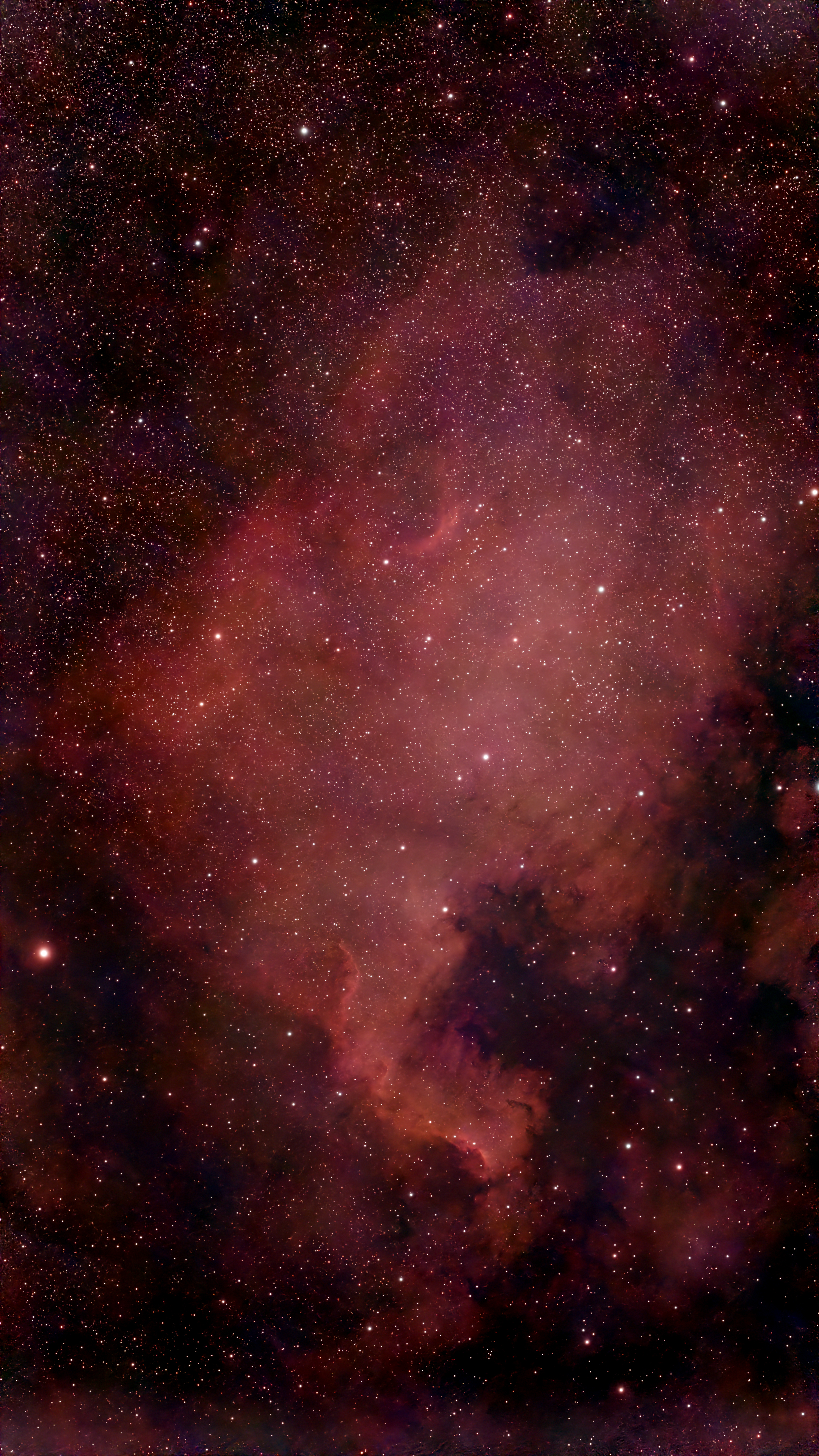
Figure 1. North America Nebula (NGC 7000), Robert Vanderbei, Princeton University. ZWO Seestar S30 Pro, f/5.
A Continent Adrift in the Swan
In our earlier Redshift post, we showcased the Crescent Nebula — an emission nebula located in the Cygnus constellation, approximately 5,000 light-years from Earth. We now revisit Cygnus, but from a closer perspective: the North America Nebula is at about 2,600 light-years, comfortably within the same span of the Swan’s wings. Although these two nebulae share a constellation, galaxy, and spiral arm, they tell remarkably different stories.
Both the Crescent Nebula and the North America Nebula reside within Cygnus — not because the constellation holds them in any physical sense, but because they happen to lie in that direction as we look outward through our galaxy. And within that shared backdrop, they tell opposite tales.
The North America Nebula is a place of beginnings. It is a stellar nursery, a vast cloud of hydrogen gas set aglow by the radiation of the Bajamar Star — a ferociously hot young star whose ultraviolet light ionizes the surrounding gas, causing it to shine. New stars are being forged within it even now.
The Crescent Nebula is a place of endings. At its heart lies WR 136, a Wolf–Rayet star — a massive, aging star in the final violent chapter of its life. The nebula itself is the wreckage of that star’s dying: a fast stellar wind tearing outward and slamming into the slower shell of gas the star shed when it swelled into a red giant some 250,000 years ago. The collision sculpts the glowing crescent we see today. It is, in the most literal sense, a dying star carving its own shroud.
Birth and death, held within the same constellation. In Cygnus the Swan, the sky keeps both. Figure 1 shows the positions of both nebulae in the constellation Cygnus and the other stars in the vicinity.
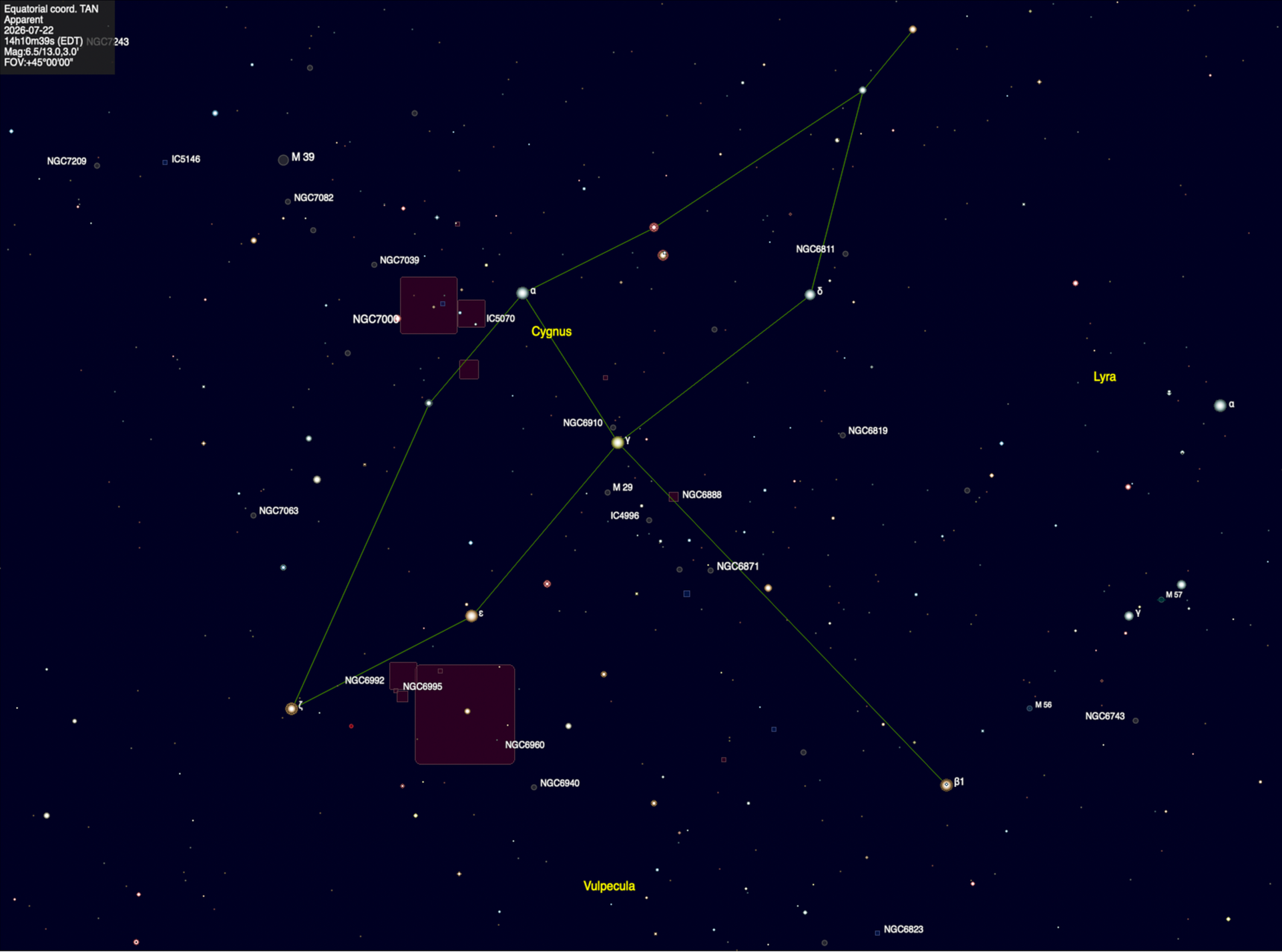
A few points to note here: The map accurately represents the relative positions and patterns of the principal stars in the Cygnus–Lyra–Vulpecula region, as well as the locations of the major deep-sky objects shown. The principal stars of Cygnus, including Deneb, Sadr, Albireo, and Gienah, are correctly situated, and familiar objects such as the North America, Pelican, Crescent, and Veil nebulae appear in their appropriate regions of the sky. The constellation lines provide a useful visual guide to the recognizable stellar patterns.
As with any such chart, however, the map is a representation rather than a literal picture of the night sky. The apparent sizes of stars and deep-sky objects are symbolic, and the wide field of view and map projection affect the appearance of distances and shapes. Fainter objects may also be absent depending on the display settings.
Subject to these limitations, the underlying Cartes du Ciel chart provides a reliable and scientifically appropriate map for illustrating the location of celestial objects in this region of the sky.
| Bayer designation | Star |
|---|---|
| α Cygni | Deneb |
| γ Cygni | Sadr |
| β Cygni | Albireo |
| ε Cygni | Gienah |
| δ Cygni | Fawaris |
Table 1: In Figure 1, the objects representing the Cygnus constellation are stars, and their Bayer designations are displayed because the NGC and IC catalogs primarily designate deep-sky objects.
| NGC/IC designation | Nebula |
|---|---|
| NGC 7000 | North America |
| NGC 6514 / M20 | Trifid |
| NGC 6523 / M8 | Lagoon |
| IC 5070 | Pelican |
| NGC 6888 | Crescent |
| NGC 6960 | Western Veil |
| NGC 6992/6995 | Eastern Veil |
| IC 1318 | Butterfly |
Table 2: Deep-sky objects such as galaxies, nebulae, and star clusters are identified by larger catalog systems such as NGC and IC.
The result is this luminous shell — approximately 25 light-years across, still expanding, riddled with filaments and dense knots of gas caught in the collision. NASA’s Hubble Space Telescope once described the structure as “oatmeal trapped inside a balloon.” What Professor Vanderbei has caught here, from his garden in New Jersey, is that balloon seen whole.
But where is the swan?
Clearly, imagination does much of the work. The stars of Cygnus do not, by themselves, trace the recognizable outline of a swan. Rather, they provided a framework upon which generations of skywatchers imposed the image of the bird, guided by mythology and storytelling. The familiar lines connecting the principal stars are a later cartographic convention — a useful way of recognizing the constellation, not a literal outline of the animal. The swan, in other words, resides as much in the story we bring to the stars as in the stars themselves.
From Discovery to Revelation
How was the North America Nebula discovered? Its story began on an autumn night in 1786, when the great astronomer William Herschel, observing from Slough in England, noticed what he described as a “faint milky nebulosity scattered over this space, in some places pretty bright.” He cataloged what he could, and his son John Herschel returned to the region in 1829, recording its brightest portion.
But neither man could have appreciated the full shape of what they were looking at. The tools of their age could not reveal it. That revelation came more than a century later, in 1890, when a German astrophotographer named Max Wolf allowed a photographic plate to accumulate light over a long exposure and found the unmistakable silhouette of a continent. He named it the North America Nebula, and the name has endured ever since.
Capturing a Continent in the Sky
Let’s examine Figure 1, which shows a remarkable photograph of the North America Nebula. This isn’t a collage from space telescope images but a real photograph taken by Professor Vanderbei. He used a ZWO Seestar S30 Pro at f/5, pointing the camera at the summer sky to capture light that has traveled 2,600 years to reach us.
The deep crimson that floods the frame is the signature of hydrogen gas: specifically, the Hα emission wavelength, produced when hydrogen atoms — energized by radiation from some young, massive nearby stars — release their energy as light. The dark intrusions cutting through that red glow are not empty space. They are dense lanes of interstellar dust, opaque enough to swallow starlight whole. One of them, designated L935, is the very curtain that concealed the North America Nebula’s ionizing star for nearly a century.
Vanderbei’s image makes Wolf’s inspiration easy to understand. Tilt the photograph slightly, and the geography asserts itself: a broad glowing mass for the body of the continent, dark dust lanes carving out the Gulf of Mexico along the lower right, the wispy southern edge tracing something like Central America. The resemblance that struck Wolf over a century ago, through a far cruder instrument, is here rendered in vivid, blood-red detail.
The Hidden Star Revealed
For a long time, astronomers assumed it was Deneb itself, which is one of the brightest stars in the summer sky, close to the nebula on the celestial sphere, that made the gas glow. But Deneb is not hot enough. The nebula’s spectrum demanded a star burning at over 30,000 Kelvin, and Deneb falls well short of that threshold. The true culprit remained hidden behind L935, the dust lane so prominently visible in Vanderbei’s image as a dark intrusion bisecting the nebula’s glowing heart. That cloud blocks nearly ten thousand visible-light photons for every one that passes through.
It was not until 2004 that European astronomers Fernando Comerón and Anna Pasquali, searching at infrared wavelengths where dust is more transparent, finally identified the ionizing source: a single stellar system cataloged with the unglamorous designation J205551.3 + 435225. Subsequent study revealed it to be a binary — a ferociously hot O-type star of spectral class O3.5 paired with a companion — and the IAU formally named it the Bajamar Star in April 2026. The name is a geographical joke: the Bajamar Star is located just off the “Florida coast” of the nebula’s shape, roughly where the Bahamas would appear on a North American map. The original Spanish name for that archipelago, Islas de Bajamar, meaning “low-tide islands,” was given because many of its islands are visible only at low sea levels.
A hidden star, illuminating a continent-shaped cloud, named after islands, that only reveals itself when the water pulls back. The poetry, for once, wrote itself. And all of it — the glowing gas, the dark curtain, the ancient light — is present in a single photograph, taken not by a space telescope but by a Princeton professor and his camera, under an open sky.
M1 — The Crab Nebula
The supernova Chinese astronomers watched in broad daylight, 1054 AD