


Deep-Sky Astrophotography with Professor Robert Vanderbei
This post lays the groundwork for the Redshift series. Instead of focusing on a single nebula, galaxy, star cluster, or other celestial object, it introduces the conventions astronomers use to describe, identify, and navigate the night sky.
Astronomy can seem to have its own language. Stars may be known by both familiar and Greek-letter names, while deep-sky objects often appear under several catalog numbers. These labels are not arbitrary. They reflect centuries of observation, discovery, and the ongoing effort to map an immense and varied Universe.
Understanding these conventions will make the posts that follow easier and more rewarding to read. As Redshift turns to individual objects and regions of the sky, readers will be able to recognize why an object may have more than one name, what those names reveal about its history, and how astronomers use them to connect observations across charts, catalogs, and photographs.
A Note on the Names and Numbers
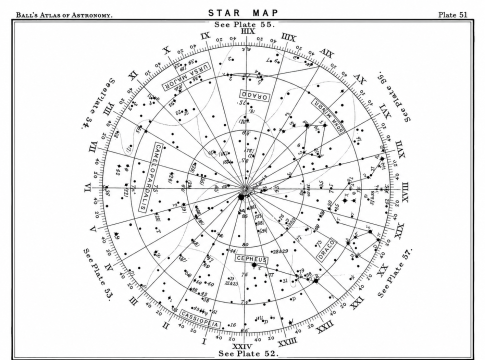
The star charts included with this article were created using Cartes du Ciel, free, open-source planetarium software that can generate sky charts from data in numerous astronomical catalogs. The charts can also display the positions of planets, asteroids, and comets.
Readers will encounter several ways to identify objects on these charts. Individual stars may carry a traditional name as well as a Bayer designation, introduced by Johann Bayer in his 1603 star atlas Uranometria. The designation combines a Greek letter with the constellation name in its Latin genitive form: α Cygni, for example, is Deneb, while β Cygni is Albireo. The Greek letters often roughly follow apparent brightness within a constellation, although this rule is by no means universal.
Another familiar system is the Messier designation, in which the letter M is followed by a number. In the eighteenth century, French astronomer Charles Messier, an avid comet hunter, began cataloging faint, stationary objects that might otherwise be mistaken for comets. The resulting Messier Catalog contains 110 deep-sky objects, including nebulae, star clusters, and galaxies. Thus the Trifid Nebula is M20, the Andromeda Galaxy is M31, and the Orion Nebula is M42.
NGC and IC are much larger catalog systems used primarily for deep-sky objects such as galaxies, nebulae, and star clusters. NGC refers to the New General Catalogue, compiled by J. L. E. Dreyer and published in 1888. Its 7,840 entries drew substantially upon observations by William Herschel and his son John Herschel (see the infobox The Herschels: The Family That Mapped the Cosmos). Dreyer later published two supplementary Index Catalogs, IC I in 1895 and IC II in 1908, adding more than 5,000 objects.
Why so many names and numbers? These systems arose at different times and for different purposes, and later catalogs often incorporated objects already known under earlier designations. The result is that a single celestial object may have several identities. The Trifid Nebula, for example, is both M20 and NGC 6514. Deneb is also α Cygni; the North America Nebula is NGC 7000; and the Pelican Nebula is IC 5070. Far from being merely redundant, these overlapping names preserve something of the history of how astronomers gradually mapped the sky.
For a historical overview of how these principal naming and cataloging systems developed—from Bayer’s seventeenth-century stellar designations to the Messier, NGC, and IC catalogs—see the section A Brief History of Astronomical Catalogs. Throughout Redshift, we generally use the familiar name when one is well established, while retaining catalog or stellar designations where they are useful.
A Brief History of Astronomical Catalogs
Astronomical naming and cataloging systems developed over several centuries, often for very different purposes. The table below provides a brief historical overview of the principal systems encountered in Redshift.
(Scroll left to view the table in a phone screen)
| Catalog / Designation | Date | Creator | Objects Covered | History / Purpose | Example |
|---|---|---|---|---|---|
| Bayer Designation | 1603 | Johann Bayer | Stars | Introduced in the star atlas Uranometria. Prominent stars within a constellation were identified by Greek letters followed by the Latin genitive form of the constellation name. | α Cygni = Deneb |
| Messier Catalog (M) | 1771–1781 | Charles Messier, with contributions from Pierre Méchain | Nebulae, star clusters, and galaxies | Developed largely to identify fixed, diffuse objects that comet hunters might otherwise mistake for comets. The modern Messier Catalog contains 110 objects. | M20 = Trifid Nebula |
| Herschel Catalogs | 1786–1802 | William Herschel | Nebulae and star clusters | Herschel’s systematic telescopic surveys greatly expanded the known population of deep-sky objects beyond those listed by Messier and provided much of the observational foundation for later catalogs. | Thousands of nebulae and clusters |
| General Catalog (GC) | 1864 | John Herschel | Nebulae and star clusters | Consolidated and extended observations by William and John Herschel and other astronomers into a catalog of 5,079 objects. It became the principal precursor of the NGC. | Precursor of the NGC |
| New General Catalog (NGC) | 1888 | J. L. E. Dreyer | Nebulae, galaxies, and star clusters | Built upon the Herschels’ work and other observations to create a much larger and more systematic catalog containing 7,840 deep-sky objects. | NGC 6514 = Trifid Nebula |
| Index Catalogs (IC) | 1895 and 1908 | J. L. E. Dreyer | Nebulae, galaxies, and star clusters | Published as two supplements to the NGC, incorporating more than 5,000 additional objects as astronomical observations and photographic surveys expanded. | IC 5070 = Pelican Nebula |