



Editor’s Note:
Chemistry is all around us—not only in laboratories, but also in the ordinary moments that begin each day. This article invites readers to see the chemistry woven into ordinary moments, revealing how everyday rituals quietly brim with molecular wonder. Blending scientific insight with engaging storytelling, it opens the first installment of a new series that uncovers the science hidden behind the familiar objects and experiences we rarely pause to consider.
Prologue
I awake each morning with a new sparkle in my eye — chemistry has woven its magic into every corner of my day, and Marc feels it too. I, Amanda, stand by the sink as water arcs and dances, each droplet a tiny ballet of H₂O molecules, ready to baptize the world in freshness. Beside me, Marc watches in wonder as the soap glides across his palm, its sudsy foam a living tapestry of surfactant strands and water-loving heads reaching for grime.
Chemistry, O Chemistry! You are the silent conductor of our daily rituals. From that first quench of water on parched lips to the gentle caress of soap lather over tired hands, you choreograph a festival of delight. In the shape-memory foam of my bed, I feel your comforting embrace; in the gleam of clean dishes, your triumphant melody. Life brims with molecular marvels — so today, I want to call out to every molecule: “Good morning! Reveal your secret dance!” And so, with Marc at my side, our celebration begins — an ode to water and soap, and the chemistry that brings them to life.
Wake up Water Calls!
“Wake up, wake up!” calls little Amanda’s mother, nudging her through the soft haze of dawn. Still half-asleep, Amanda pads across her bedroom to the bathroom, her feet whispering against the cool tiles. Before her, neatly lined up on the sink’s edge, sit the familiar cast of morning helpers: liquid soap, toothpaste, toothbrush, tissues. Yesterday, these objects were simply everyday tools. Today, thanks to her very first chemistry lesson at school, they gleam with new intrigue.
As Amanda grips the shiny chrome faucet and turns it, a ribbon of clear water arcs into her waiting palm. The droplets feel smooth and insistent, slipping through her fingers in a cool cascade. Instantly, her mind flutters back to summer days on the beaches of Goa, where she scooped handfuls of golden sand and watched it tumble through her fingers just as water does. Could water and sand be cousins of a kind, she wonders? What hidden threads tie these two seemingly different flows together?
In the science lab, Amanda learned that true liquids—like water—are made of molecules that glide past one another with almost balletic ease. Invisible attractions between neighbors keep them loosely connected, but never rigidly fixed. Pour a jug of water, and the entire mass melds into a smooth, continuous stream. Sand, by contrast, is a crowd of tiny, solid grains, each one rigid and unyielding. Tip an hourglass, and sand pours in a way that looks remarkably like water, forming ripples and little bridges of falling grains. How does a pile of hard particles mimic the fluidity of a liquid?
To answer this, we must dive into the microscopic world. Picture water as a vast sea of minuscule spheres—water molecules—each one constantly jostling and dancing around its neighbors. In a liquid state, these molecules form fleeting connections through hydrogen bonds, attaching and detaching in a rapid, invisible dance. At any given moment, each molecule has about four or five neighbors, but these partnerships change millions of times per second. This dynamic network allows molecules to slip past one another, giving water its liquid character.
Sand, on the other hand, belongs to the realm of granular materials, a category where solids can behave like liquids and, intriguingly, liquids can behave like solids. Each grain of sand is a rigid particle that interacts with its neighbors through contact forces—pushing, sliding, and occasionally locking together. When you pour sand from a scoop or an hourglass, gravity pulls the grains downward, briefly breaking their contacts so they can flow in a fluid-like stream. Once the motion stops, the grains settle into stable arches and heaps, behaving like a solid mass. This dual personality—liquid when flowing, solid when still—makes sand a fascinating bridge between familiar fluids and rigid solids.
But water has secrets of its own. When temperatures fall, the hydrogen-bond dance slows, and molecules begin to settle into a fixed, crystalline arrangement: ice. In this solid form, each water molecule locks into a tetrahedral lattice, coordinating with exactly four neighbors in a perfectly ordered pattern. This open, hexagonal packing leaves more empty space than the denser liquid arrangement, which is why ice floats on water. Imagine building a sand pyramid with large gaps between grains—such a structure would be both rigid and surprisingly light.
As the sun warms the ice, heat energy disrupts those neat hydrogen bonds. Molecules jiggle and break free, slipping past one another as more compact arrangements briefly form. The average number of neighbors—known as the coordination number—remains close to four but becomes a lively statistic rather than a fixed rule. In this molten dance, water sheds its crystalline rigidity and regains its fluidity.
The transition from ice to water illustrates the powerful role of packing in determining a material’s properties. In ice, open tetrahedral packing creates a rigid scaffold. In liquid water, molecules pack more closely, filling voids and allowing bonds to form and break in rapid succession. This tighter, ever-shifting network of interactions is what gives water its remarkable ability to flow, conform to containers, and dance along surfaces.
Returning to sand, we see a parallel. If you gently shake a container of sand, grains rearrange into a denser packing, occasionally locking into new stable configurations. Under vigorous agitation, the grains collide so energetically that they remain nearly suspended, flowing like a liquid until the shaking stops. Just as water molecules adjust their neighbors to switch between solid and liquid, sand grains reorganize under different forces to reveal their own hidden fluidity.
For Amanda, the simple act of washing up becomes a primer in materials science. The cool water on her skin and the memory of sand on her fingers invite questions about the fundamental nature of matter. How do tiny invisible forces give rise to flows we see every day? Why does ice float and water run? What hidden dances occur beneath the surface of every drop and every grain?
Modern research stretches these questions even further, exploring granular physics in industries ranging from pharmaceuticals to construction. Engineers study how powders flow through hoppers, how to prevent clogs in grain silos, and how to create materials that can switch between soft and hard states on demand. Meanwhile, chemists probe water’s anomalies—like its unusually high boiling point for a molecule of its size and its mysterious density maximum at 4 °C—seeking insights into hydrogen bonding and molecular packing.
So next time you watch water pour from a jug or sand tumble from an hourglass, pause and imagine the tiny worlds in motion. The flows arise from neighbors letting go and then grasping new ones: in water, through fleeting hydrogen bonds; in sand, through momentary loss of contact and renewed collisions. Despite their differences, both exhibit the same fundamental principle—matter in motion emerges from changing connections among its smallest parts.
Science often begins with a simple question: “Why?” For Amanda, brushing her teeth became an invitation to explore the hidden dramas of molecules and grains. For all of us, the ordinary materials around our homes and hands hold extraordinary stories waiting to be told. Whether you chase droplets or grains, remember that every flow—liquid or granular—whispers secrets of coordination, packing, and the marvelous dance of matter itself.
Amanda’s gaze now settles on the bottle of liquid soap beside the sink. The morning light refracts playfully through its foamy swirl, turning an everyday task into an invitation to wonder. She remembers her chemistry lessons: water molecules dancing in an invisible ballet, sand grains flowing like water in an hourglass. But what of soap? How does a simple squeeze of this colored liquid summon clouds of foam? And beyond the froth, how does soap transform grimy hands into clean ones?
At first glance, foam seems like nothing more than a mass of tiny bubbles, each one a perfect sphere. Yet these spheres owe their existence to the phenomenon known as surface tension. Imagine a tightly stretched trampoline membrane—pull it too far, and it snaps; leave it slack, and it droops. Water’s surface behaves much the same way. Molecules at the surface are pulled inward by their neighbors below, creating a thin, elastic “skin.” This skin resists deformation, giving water droplets their rounded shapes. But water alone struggles to form stable bubbles—any gust of air or bump of the faucet will collapse the fragile membrane.
Enter the soap. Soap molecules are a special class of chemicals called surfactants (short for “surface-active agents”). Each surfactant molecule has two distinct ends: a water-loving, or hydrophilic, head, and an oil-loving, or hydrophobic, tail. Picture a tiny tadpole, where the round head happily swims in water while the skinny tail recoils from it. When you add soap to water, these amphiphilic molecules race to the air–water interface, jostling for space. The hydrophobic tails stick out of the water, while the hydrophilic heads plunge into it. By inserting themselves into water’s surface, surfactants weaken the cohesive pull between water molecules, reducing surface tension and making the surface membrane more flexible.
With lower surface tension, it becomes far easier to trap air into the liquid and stabilize bubbles. When Amanda rubs her hands together, she’s not just creating friction; she’s mixing air into a liquid that’s been carefully “softened” by surfactants. Tiny soap-laden films stretch around pockets of air, creating the joyful foam she knows so well. Each bubble is a thin sandwich: a soap–water film between two layers of air. The soap molecules on the inner and outer surfaces hold the film together, preventing it from snapping back like an overstretched rubber band.
But the magic of soap goes far beyond frothy delight. It’s the same hydrophobic tails that give surfactants their cleaning superpower. Dirt, grease, and oils on Amanda’s hands are composed of substances that water alone can’t dissolve—they’re hydrophobic, too. They repel water just as oil and vinegar refuse to mix. When soap is present, however, surfactant molecules arrange themselves around each speck of grease: the hydrophobic tails dive into the oily grime, while the hydrophilic heads stay anchored in the surrounding water. This creates tiny, spherical assemblies called micelles.
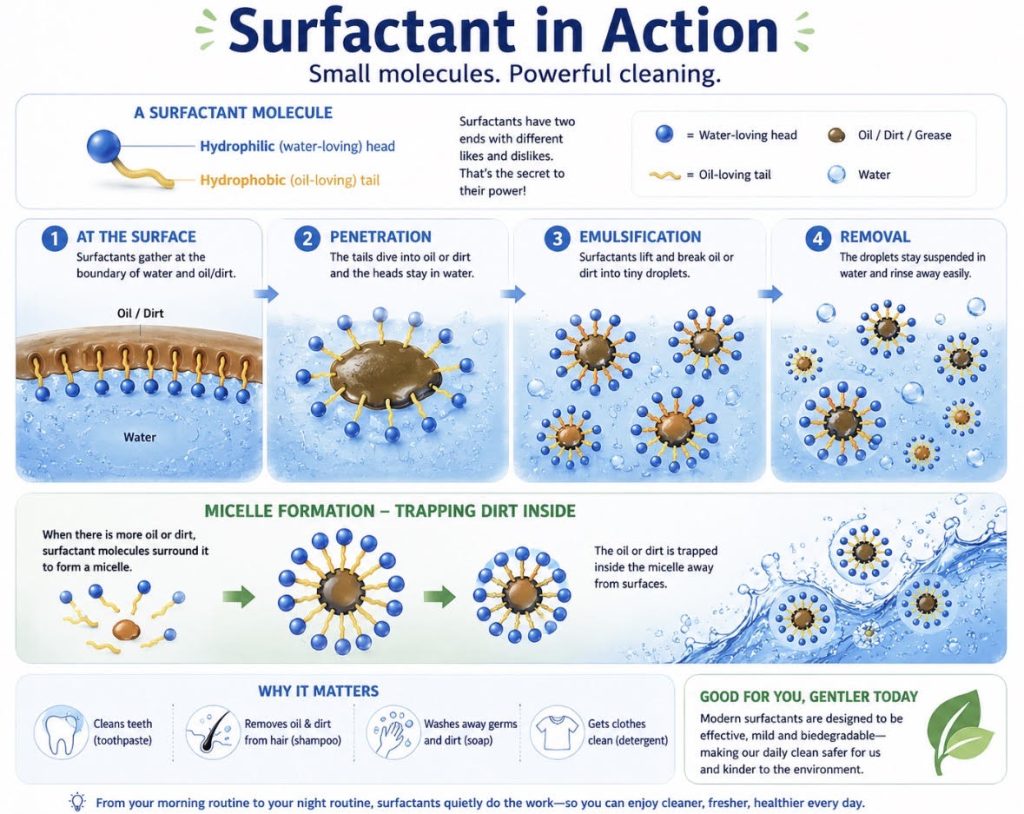
A micelle is essentially a greasy ball wrapped in water-friendly coats. Imagine a core of oil, coddled by thousands of surfactant tails in its center, its heads pointing outward like the bristles of a brush. Inside this protective sphere, the dirt is trapped and isolated from the rest of the water. The result? A stable dispersion that allows the entire cluster of oil and soap to rinse away under running water. Without soap, oil droplets would cling stubbornly to skin or fabric; with soap, they’re whisked away, hidden within invisible micellar vessels.
This process of encapsulating hydrophobic particles within micelles is known as emulsification. It’s the same principle behind vinaigrette dressing: mustard acts as a natural surfactant, helping oil and vinegar meld into a uniform sauce. In Amanda’s case, the surfactant-laden water transforms into a cleaning orchestra, where each molecule plays a role in liberating dirt from her skin. The gentle bubble foams up, loosening grease; micelles form and shuttle away grime; rinsing water washes the whole assembly down the drain.
Yet soap’s story is richer still. Different surfactants have different strengths, measured by the critical micelle concentration (CMC)—the point at which adding more soap no longer reduces surface tension but instead drives micelle formation. Below the CMC, soap molecules primarily occupy the surface, lowering tension and aiding bubble formation. Above it, micelles proliferate, supercharging the cleaning power. Manufacturers carefully balance these properties to create soaps that lather generously while still rinsing easily, leaving no sticky residue.
Consider next the feel of soap on Amanda’s skin. She notices how it seems to soften water’s hardness—another hidden benefit of surfactants. Hard water contains minerals like calcium and magnesium, which can neutralize soap and leave scummy deposits. Surfactants scavenge these ions, forming soluble complexes that wash away cleanly. The foam she enjoys is not just pleasing to the eye; it’s a sign of surfactants hard at work, tackling multiple cleaning challenges.
Beyond handwashing, surfactants and micelles power a vast array of everyday phenomena. In industry, they help in enhanced oil recovery, carrying trapped crude from porous rocks deep underground. In medicine, they stabilize drug formulations, ensuring even distribution of active ingredients. In environmental science, they assist in cleaning up oil spills, coaxing oil slicks into emulsions that break down more readily under microbial attack. All of these feats trace back to the deceptively simple idea of a molecule with two incompatible halves—one that loves water, and one that does not.
By the time Amanda splashes her face and rinses away the soap, she’s unwittingly witnessed a symphony of molecular interactions. A single squeeze of liquid soap initiated a cascade: surfactants lowered surface tension, foams formed, micelles trapped oils, and water carried impurities away. The bathroom sink became a miniature laboratory of surface chemistry. What seemed like mundane morning chores revealed deep truths about how molecules organize, interact, and transform our world.
Epilogue
As she pats her hands dry, Amanda smiles. Tomorrow, she’ll return to school and perhaps learn about polymers or pH scales. Thereafter the stories of toothpaste and toothbrush will become more lucid. But today, she’s discovered that even the simplest household items—water and a bottle of soap—embodies a universe of scientific wonder. Science often begins with the questions—“What is water and how does soap clean?”—and unfold into a journey through liquids, granular matter, surface tension, hydrophobicity, hydrophilicity, and the self-assembly of micelles. All it takes is curiosity…and a moment to watch the bubbles dance. Time flies. Amanda rushes to ready herself for the school! She looks forward to the Chemistry class!
Further Reading
Le Couteur, P.; Burreson, J. Napoleon’s Buttons: How 17 Molecules Changed History; Jeremy P. Tarcher/Penguin: New York, NY, 2003.
Kean, S. The Disappearing Spoon: And Other True Tales of Madness, Love, and the History of the World from the Periodic Table of the Elements; Little, Brown and Company: New York, NY, 2010.
Emsley, J. Molecules at an Exhibition: Portraits of Intriguing Materials in Everyday Life; Oxford University Press: Oxford, U.K., 1998.
Keeler, J.; Wothers, P. Why Chemical Reactions Happen; Oxford University Press: Oxford, U.K., 2003.
Miodownik, M. Stuff Matters: Exploring the Marvelous Materials That Shape Our Man-Made World; Houghton Mifflin Harcourt: Boston, MA, 2014.
Emsley, J. Vanity, Vitality, and Virility: The Science behind the Products You Love to Buy; Oxford University Press: Oxford, U.K., 2004.