

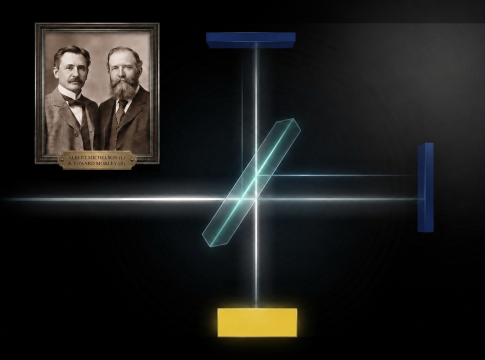


Editor’s Note
Few experiments are as famous — or as misunderstood — as the Michelson–Morley experiment of 1887. Often portrayed as a simple refutation of the luminiferous ether and a direct precursor to Einstein’s special relativity, its true history is considerably more subtle. This essay follows the difficult path leading to the experiment, the ingenious and often misunderstood responses of ether theorists such as FitzGerald and Lorentz, and Einstein’s own surprisingly nuanced reaction to the celebrated null result.
Why should we still care about an experiment performed nearly 140 years ago? The answer lies not only in its role in reshaping our understanding of space and time, but also in the remarkable legacy of its underlying technique: optical interferometry. The same basic method that Michelson and Morley employed in their search for the ether evolved into one of the most powerful tools in modern science. In 2015, interferometers at LIGO made history by directly detecting gravitational waves from colliding black holes, opening an entirely new window on the Universe.
The story that unfolds here is therefore more than a chapter in the history of physics. It is a reminder of how scientific ideas evolve through experiment, interpretation, and the continual rethinking of first principles — and how a nineteenth-century quest to detect the ether ultimately helped make possible some of the most profound discoveries of the twenty-first century.
Scroll within the window or use the up and down arrows to view the article.