

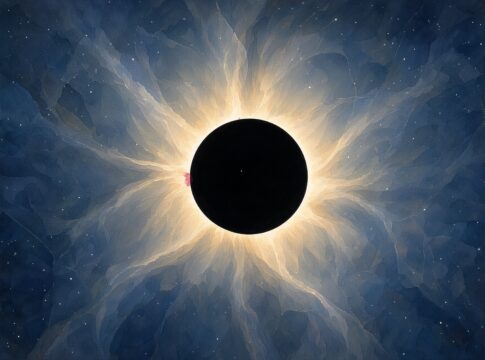

What makes a total solar eclipse so spectacular? As daylight fades to a coppery hue, familiar images of people gazing skyward through protective glasses fill newspapers and social media. Soon, the Moon appears to take its first bite from the Sun: the show has begun.
Then, with startling speed, the scene transforms. The Sun’s final brilliant sliver vanishes. Temperatures drop, and bewildered wildlife falls quiet. A 360-degree sunset glows along the horizon, while faint shadow bands can ripple across the ground in the last moments before total darkness.
At totality, the familiar Sun is gone. In its place hangs a black disk surrounded by the luminous, filamentary halo of the solar corona.
The spectacle is extraordinary. Yet the geometry that makes it possible is almost as remarkable as the sight itself. The Sun is about 400 times wider than the Moon, but it is also roughly 400 times farther from Earth. The two therefore appear nearly the same size in our sky. That near-match — not merely the fact that the Moon can cover the Sun — is the central wonder of a total solar eclipse.
To understand why, it helps to ask a simple question: What would eclipses look like if the Moon were a little larger or a little smaller?
The Geometric Coincidence
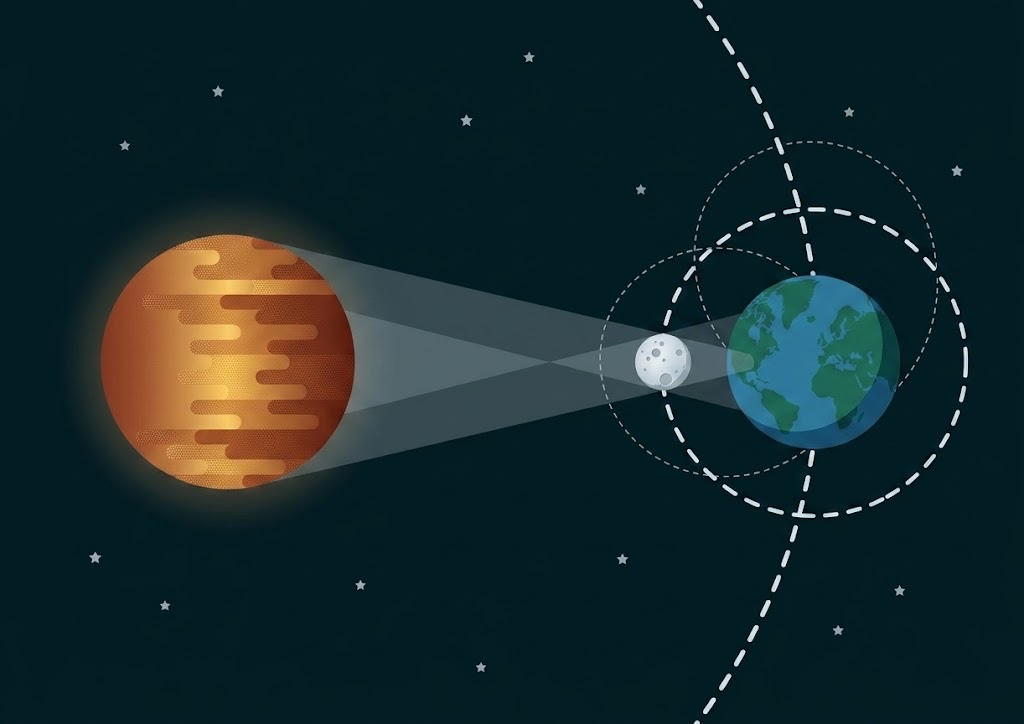
A solar eclipse occurs when the Moon passes between the Sun and Earth and casts its shadow on Earth [1]. The apparent angular size of an object depends, to a good approximation for small angles, on the ratio of its physical diameter to its distance:
θ ≈ D d
For the Sun and Moon as seen from Earth,
D☉ D☾ ≈ 400, d☉ d☾ ≈ 400.
Their angular diameters are therefore remarkably similar. Because the distances vary over their slightly elliptical orbits, the match is not always exact. Sometimes the Moon appears large enough to cover the Sun completely; sometimes it does not.
That small variation is the difference between a total eclipse and an annular one.
Why Don’t Eclipses Happen Every Month?
Earth circles the Sun once each year, while the Moon orbits Earth roughly once a month. It might therefore seem that every new Moon should produce a solar eclipse. It does not.
The Moon’s orbital plane is tilted by about five degrees relative to the ecliptic, the plane of Earth’s orbit around the Sun. Most months, the new Moon passes slightly above or below the Sun in our sky. An eclipse can occur only when the new Moon is also close to one of the two points – called nodes – where its orbit crosses the ecliptic plane.
When the alignment is close enough, the Moon’s shadow falls on Earth. The dark central portion of that shadow is the umbra; an observer inside it sees the Sun completely covered. The much broader penumbra produces a partial eclipse [2].
The duration of totality is not fixed. It depends on the particular eclipse and on the observer’s position within the path of the umbra. It may last only seconds or several minutes. During the August 12, 2026 eclipse, for example, most locations in the path of totality experienced less than two minutes of complete coverage [3].
What If the Moon Were a Different Size
Now we can see why the familiar “400-to-400” coincidence matters. Keep the present Sun – Earth and Moon – Earth distances unchanged, but imagine changing only the Moon’s diameter.
Suppose the Moon were larger: 1/300 the Sun’s diameter
If D☉ D☾ = 300, while the distance ratio remained approximately 400, then the Moon’s apparent diameter relative to the Sun would be
θ☾ θ☉ ≈ 400 300 ≈ 1.33.
The Moon would appear about 33% wider than the Sun. Total eclipses would still occur, and a well-centered eclipse could place the Sun well inside the lunar silhouette. The path of totality could be wider, and totality could last longer. But there would be a price: more of the inner corona close to the Sun’s limb would be hidden behind the oversized lunar disk.
Our Moon: approximately 1/400 the Sun’s diameter
At roughly the present ratio, the two disks are nearly matched. The Moon can cover the brilliant photosphere while leaving the surrounding corona exposed. This is the geometry that produces the familiar black Sun surrounded by a luminous crown.
The true marvel, then, is not simply that the Moon can cover the Sun. A larger Moon could do that too. The marvel is the precision of the apparent match.
Suppose the Moon were smaller: 1/500 the Sun’s diameter
Now imagine D☉ D☾ = 500. With the distance ratio still near 400,
θ☾ θ☉ ≈ 400 500 = 0.80.
The Moon would appear only about 80% as wide as the Sun. Even during perfect central alignment, it could not cover the solar photosphere completely. There would be no total solar eclipses. Instead, a bright ring of exposed photosphere would remain around the Moon.
That ring would overwhelm the much fainter corona, preventing the corona from becoming visible to the unaided eye.
| Moon/Sun diameter | Apparent Moon | Likely result |
|---|---|---|
| 1/300 | Too large | Deep total eclipse; more inner corona hidden |
| ≈ 1/400 | Nearly matched | Total eclipse with the corona dramatically exposed |
| 1/500 | Too small | No total eclipse; annular eclipse at central alignment |
Total, Annular, and Partial Eclipses
The real Moon’s distance from Earth changes during its elliptical orbit. Consequently, its apparent diameter changes as well. If a favorable alignment occurs when the Moon appears large enough, its umbra reaches Earth and observers within it see a total eclipse.
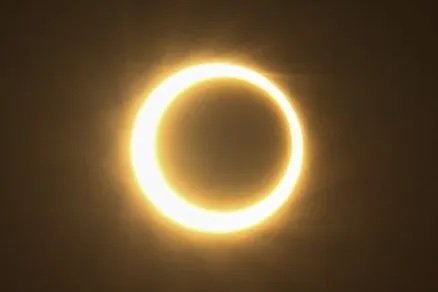
If the Moon is farther away and appears slightly smaller than the Sun, its umbra falls short of Earth’s surface. Even at central alignment, a narrow ring of photosphere remains visible around the lunar silhouette. This is an annular eclipse – the celebrated “ring of fire”; see Figure 2.
A partial eclipse occurs for observers outside the umbra or when the alignment is not central enough for the Moon to cover the Sun completely. The Moon then seems to take a curved “bite” from the solar disk. The Sun remains far too bright for the corona to become visible, but the changing silhouette provides a direct demonstration of orbital motion.
Photographing the Corona
Few astronomical sights are as striking as the corona, and few are more difficult to photograph well. Its brightness falls dramatically from the inner corona to its faint outer streamers, producing a dynamic range that a single exposure cannot easily capture.
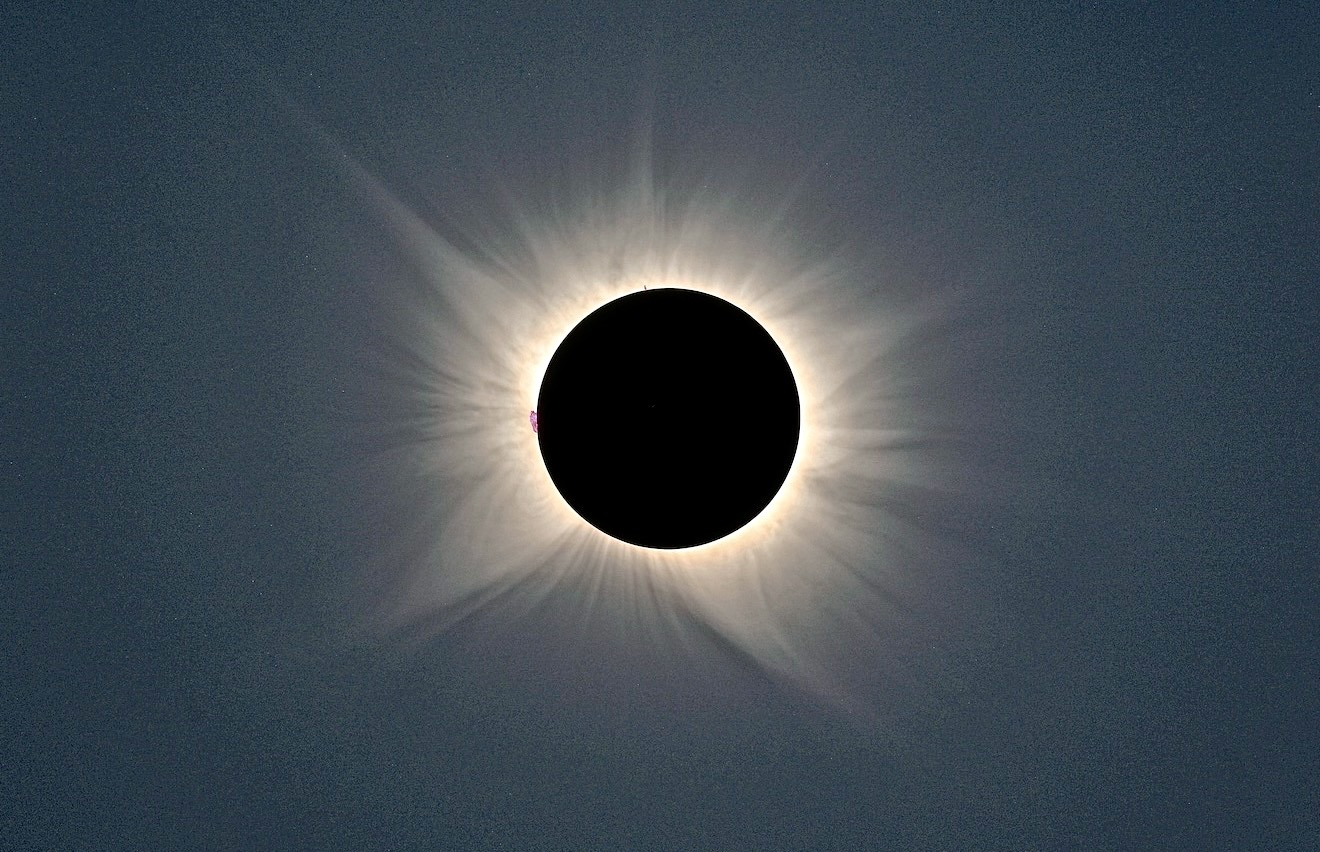
During the August 12, 2026 total eclipse, meteorologist and atmospheric scientist Matthew Cappucci photographed the corona from T’ortoles de Esgueva, Spain. He selected the location in part because totality occurred near sunset, allowing the low Sun and atmosphere to cast a warm glow on the scene [4].
Using a 600 mm lens, Cappucci recorded a bracketed sequence of exposures: short exposures preserved bright structures near the solar limb, including Baily’s beads and the inner corona, while longer exposures revealed faint outer streamers. He later aligned and blended five exposures, using a single sharp lunar disk to avoid motion blur and matching the color to a wide-angle reference image. The result (Figure 3) demonstrates why eclipse photography is not simply a matter of pressing the shutter at totality: the camera must somehow accommodate structures that differ enormously in brightness.
A Partial Eclipse over New Jersey
The August 12, 2026 eclipse brought totality to a narrow path crossing Greenland, Iceland, northern Russia, the Atlantic, Spain, and a small corner of Portugal. Across parts of the northern United States, including the Mid-Atlantic, only a partial eclipse was visible [3].
From New Jersey, this was no spectacle of sudden darkness. Only a small fraction of the Sun disappeared. Yet the modest eclipse offered something else: a chance to watch celestial mechanics unfold in real time.
Professor Robert Vanderbei captured the event from Mays Landing, New Jersey, while visiting his colleague Alain Kornhauser. Using Kornhauser’s Seestar S50 smart telescope, Vanderbei recorded a series of time-lapse videos following the roughly 75-minute progression of the partial eclipse. Each sequence documented another portion of the Moon’s passage across the Sun. He later combined the clips into a single 20-second time-lapse showing the event as one continuous motion; see Figure 4.
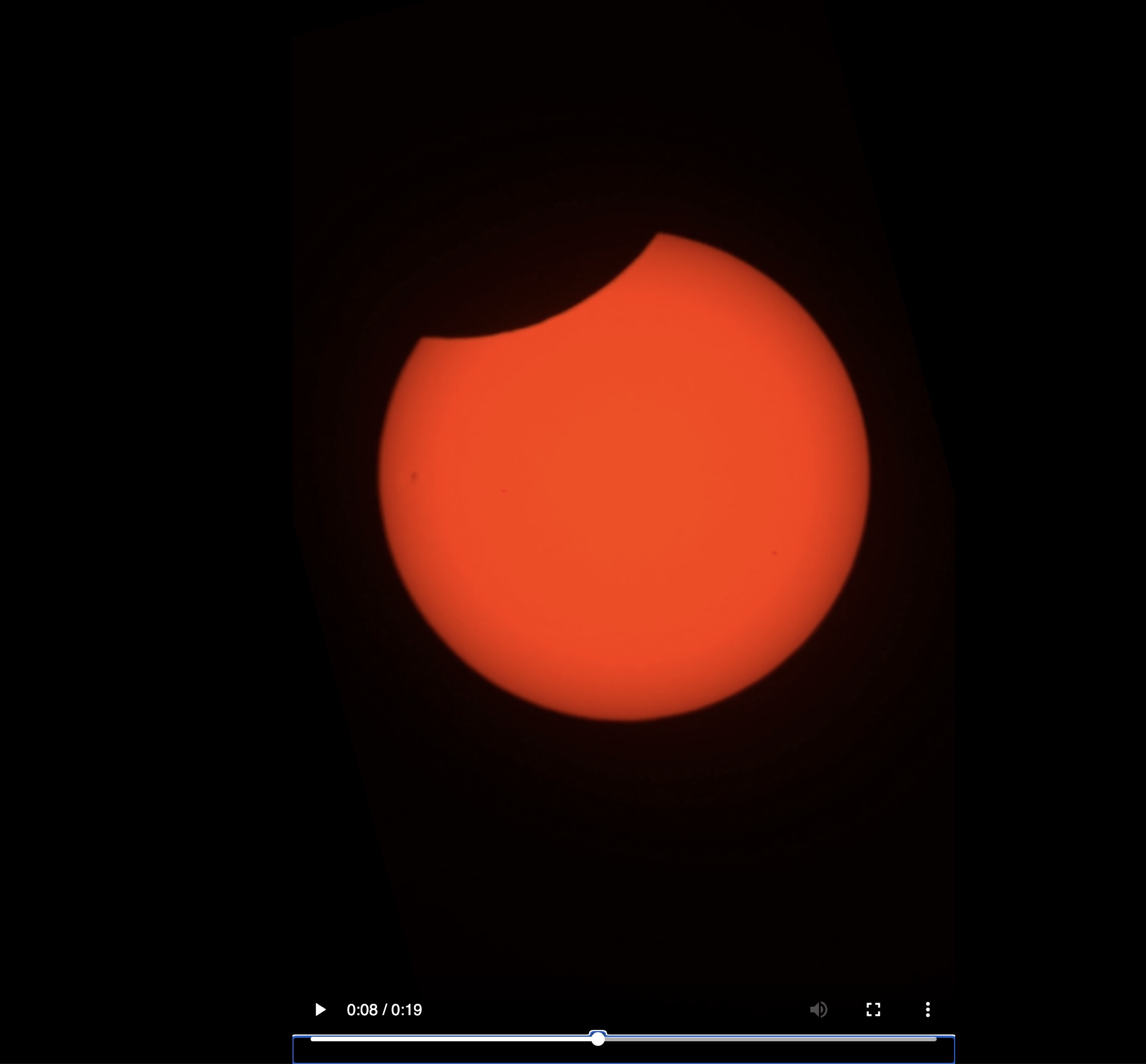
Presented here in Redshift, Vanderbei’s time-lapse is both a scientific record and a visual reminder that an eclipse need not reach totality to reveal the elegance of celestial geometry. Modern, off-the-shelf instruments can turn even a modest partial eclipse into a compact record of the Moon moving across our line of sight to the Sun.
Click to watch Robert Vanderbei’s time-lapse here. Otherwise, scroll down to watch it on YouTube.
Mythology
Modern astronomy allows us to watch this celestial geometry unfold with remarkable precision. But humans witnessed the same startling spectacle for thousands of years before they understood the orbital motions that produced it. When the Sun suddenly vanished in the middle of the day, different cultures sought explanations in myth, religion, and cosmic symbolism. In Hindu mythology, for example, the eclipse was associated with Rahu, who attempts to swallow the Sun; elsewhere, dragons, heavenly dogs, divine omens, and other cosmic agents were invoked to explain the unexpected darkness. These stories remind us that long before an eclipse became a problem of celestial mechanics, it was one of humanity’s great mysteries.
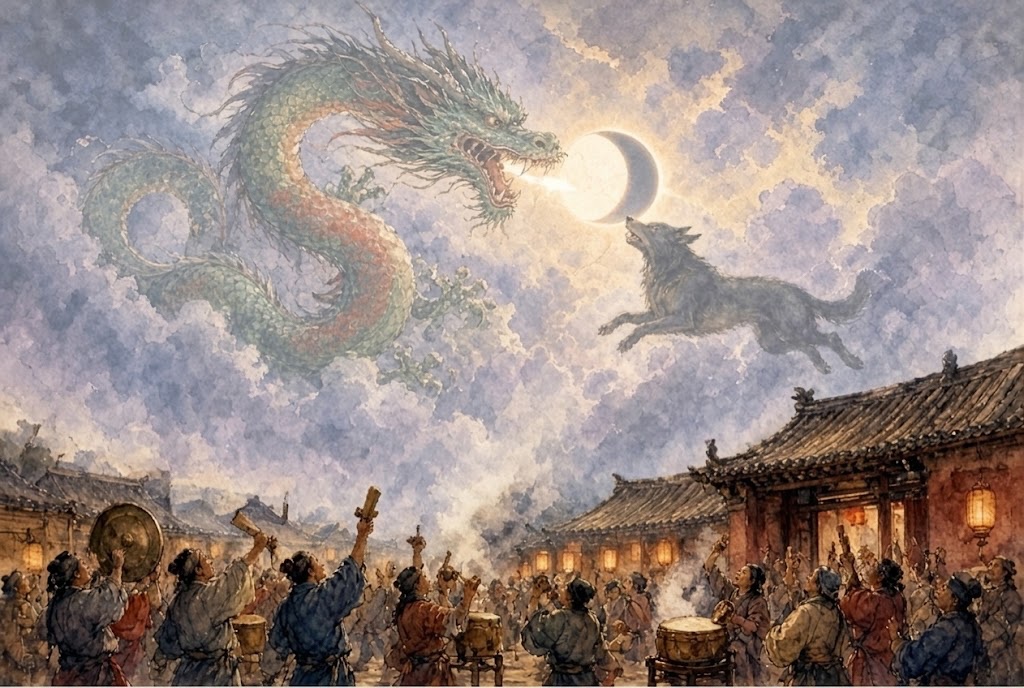
Jewish and Christian traditions tend less often to explain an eclipse through a creature’s assault on the Sun and more often interpret celestial darkness as a divine sign. Rabbinic literature, for example, describes a solar eclipse as an ominous event for the world, comparing it to a king who removes a lamp from a banquet in anger at his servants. Biblical prophetic writings likewise use the darkening of the Sun to evoke judgment, disaster, and the approaching “day of the Lord.” In Christianity, the most resonant eclipse-like episode is the darkness reported during Jesus’s crucifixion, when the Gospels describe darkness falling over the land for several hours. Although this was not, astronomically speaking, an ordinary solar eclipse, Christian tradition has understood it as a supernatural sign of grief, judgment, and the cosmic importance of Christ’s death. Together, these stories show how different cultures turned the startling darkness of an eclipse into narratives of conflict, warning, and renewal.
A Coincidence in Time
Today, celestial mechanics has replaced dragons, demons, and omens as explanations for an eclipse. Yet science has revealed something perhaps equally astonishing: the spectacle itself is temporary. The geometry that makes a total solar eclipse possible will not last forever.
Because of tidal interactions between Earth and the Moon, the Moon is slowly receding from us at an average rate of about 3.8 centimeters per year. As its orbit expands, its apparent size in our sky gradually decreases. NASA estimates that if the present trend is extrapolated, roughly 600 million years from now the Moon will no longer appear large enough to completely cover the Sun, and total solar eclipses will cease [5].
We therefore live not only on a planet with an unusual Sun–Moon geometry, but during an epoch when that geometry permits the two disks to appear almost perfectly matched.
A total solar eclipse is more than a shadow passing across Earth. It is the consequence of an extraordinary alignment: a star and a moon, enormously different in physical size, appearing nearly identical in our sky. Had the Moon been somewhat smaller, the corona would never emerge around a completely darkened Sun. Had it been substantially larger, totality would remain, but the exquisite fit would be lost.
For now, the match is almost perfect. Perhaps that is why totality feels less like an ordinary astronomical event than a fleeting glimpse of celestial precision.
Safety Note
Except during the brief phase of complete totality, it is unsafe to look directly at the Sun without proper solar viewing protection. During partial and annular eclipses – and during the partial phases before and after totality – use certified eclipse glasses or another safe solar viewer. Ordinary sunglasses are not sufficient. Telescopes, binoculars, and cameras require appropriate solar filters mounted in front of the optics [6].
References
- B. Kundu, B. Senapati, and B. Tyagi, “A solar eclipse: Excitement is in the air,” Front. Young Minds, vol. 11, Jul. 2023.
- C. Barry, Eclipses and the moon, https://science.nasa.gov/moon/eclipses/ , accessed Aug. 30, 2026, Jun. 2023.
- NASA Science, “Total Solar Eclipse on August 12, 2026,” accessed Aug. 30, 2026. [Online]. Available: https://science.nasa.gov/eclipses/future-eclipses/total-solar-eclipse-on-august-12-2026/
- M. Cappucci, “How I captured an image of the sun’s atmosphere during a solar eclipse,” The Washington Post, Aug. 2026, accessed Aug. 29, 2026. [Online]. Available: https://www.washingtonpost.com/weather/2026/08/20/how-i-captured-an-image-suns-atmosphere-during-solar-eclipse/
- How is the sun completely blocked in an eclipse? https://spaceplace.nasa.gov/total-solar-eclipse/en/ , accessed Aug. 30, 2026.
- S. Carney, What’s up: August 2026 skywatching tips from NASA, https://science.nasa.gov/solar-system/whats-up-august-2026-skywatching-tips-from-nasa/, accessed Aug. 30, 2026, Jul. 2026.