



Editor’s Note
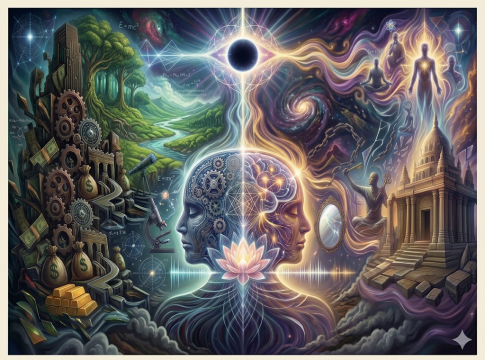
Professor P. Krishna brings a rare perspective to the relationship between scientific knowledge, education, and self-understanding, drawing on both his training as a physicist and a lifetime of engagement with the educational and philosophical questions raised by J. Krishnamurti. Rather than revisiting the familiar debate between science and religion, he invites readers to consider whether knowledge and technological power, however essential, are sufficient without wisdom and an understanding of the human mind itself. We are pleased to publish this essay because it exemplifies the kind of borderless inquiry Curiosità seeks to foster — one that crosses disciplinary boundaries and encourages reflection not only on how the Universe works, but also on how human beings understand themselves within it.
Abstract
Education today is only concerned with imparting knowledge and skills that would enable an individual to earn a living for oneself. It empowers the individual without giving him the wisdom to use that power constructively. This has produced a lop-sided mind: very efficient in one particular direction but very ignorant about himself, his relationships and his responsibility. The Buddha in the East and Socrates in the West had emphasized the need to promote self-knowledge which is the key to cultivate wisdom and come upon virtue, but we have completely ignored that inquiry in education. Education has cultivated the scientific inquiry and ignored the spiritual inquiry in the name of secularism.
The purpose of science is to discover and understand the order that manifests itself in the outer world of Nature. The purpose of humanity’s spiritual quest is to discover order in the inner world of our consciousness, in the form of peace, harmony, non-violence, joy, happiness and beauty, all of which are different elements of virtue. From time to time, in different parts of the world wise sages were born who discovered such order in consciousness. Their followers created various religions as paths to come upon that order in consciousness but did not pursue the wisdom which the teacher had.
Unfortunately, the religions got equated with belief, dogma, rituals and faith, thereby creating divisions in the world. In the West, the scientific discoveries of Galileo in the 16th century contradicted the beliefs of the Christian Church, and he was persecuted and forced to recant his findings. From that time onwards, there came a big divide between science and religion, which persists even today.
In Christianity inquiry and doubt were forbidden and treated as heresy. In the eastern religions like Hinduism, Jainism, Buddhism, Confucianism, Taoism, Zen, etc., there was belief, worship, and faith, but there was also a long legacy of doubt and inquiry into what is real and what is imaginary; what is true and what is false. There has been a long history of dialogues on these matters starting from Upanishadic dialogues, to Buddhist dialogues, Socratic dialogues and various other religious dialogues in quest of truth and wisdom.
The Buddha pointed out that all negative emotions creating disorder in consciousness arise from illusions in our mind and can, therefore, be eliminated by discerning what is true and what is false. This quest for truth does not involve any belief and therefore does not contradict the scientific quest. Krishnamurti1 pointed out that this is not merely an intellectual inquiry which only transforms ideas but when it is combined with observation of the way our consciousness functions in daily life, it can bring about a transformation of consciousness through a deep perception of what is true and what is false leading to self-knowledge and wisdom. He regarded such a learning mind as the true religious mind and stated as follows: “The religious mind has no belief, no dogma; it moves from fact to fact. Therefore, the religious mind is a scientific mind; but the scientific mind is not a religious mind. The religious mind includes the scientific mind, but the mind that is trained in the knowledge of science is not a religious mind.” In this essay I shall discuss the differences in the scientific and spiritual quests and show that they are two complementary quests for truth in two different aspects of reality, covering both the external world of Nature and the inner world of our consciousness. Both the quests have a common origin in the innate inquisitive nature of human consciousness but the questions they explore are different. The antagonism between the two quests, perceived by many in society, is born of a superficial meaning given to religion, which needs to be questioned.
Introduction
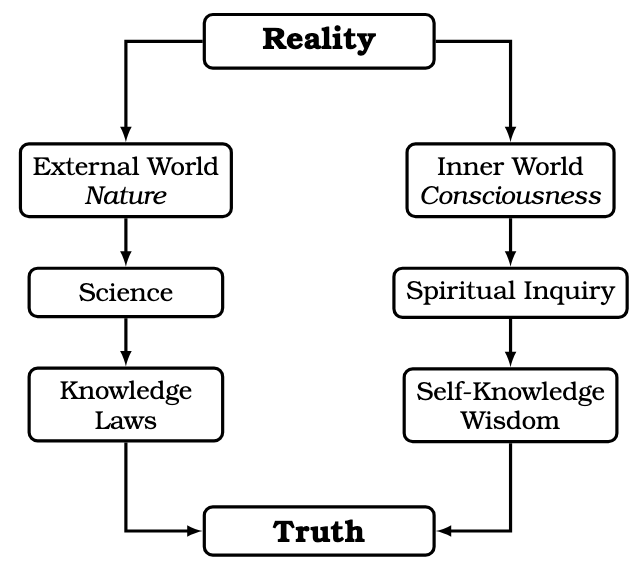
The scientific quest and the spiritual quest have been the two great quests of humanity but somehow a feeling has developed that science is antagonistic to spirituality. We should examine whether this is really so or it is because we give to science and spirituality rather narrow meanings. The purpose of the scientific quest is to discover the order in the external world of space, time, energy and matter. That of the spiritual quest is to discover order in our consciousness.
Since the whole of reality is built up of both matter and consciousness why should the quest for the understanding of order in the external world be antagonistic to the quest for the understanding of order in the inner world of our consciousness?
The relationship between the scientific and spiritual quests, as conceived in this essay, may be summarized schematically in Figure 1.
The Origin of the two Quests
If we look at their origins, we find that both quests have originated out of human inquisitiveness. We human beings want to inquire into our surroundings, into what is happening within and around us. We want to observe in order to find out. If we ask the question, “Why are we inquisitive?”, there is no answer. It is not always for a purpose. We are inquisitive by nature. The purpose is a by-product, it is not the aim of the inquiry. For instance, technology is the by-product of science, but it is not the reason for science. The scientific quest was there much before any technology developed. We were inquiring into why the sky is blue, why the sun rises and sets, why trees grow, why there are so many species around us why eclipses occur and all that, much before any technology came into being.
In the same way, questions like – Who am I?, What is the purpose of life?, Why is there so much conflict and violence within me?, Is it possible to come upon some kind of order within my consciousness? What is death? Is there something beyond death? – are all questions in the field of spirituality. Out of this quest, the different organized religions have evolved as a by-product. There were great enquirers who came upon a certain order in their consciousness – we may call that order love, compassion, harmony, virtue, or whatever. Out of that state, they tried to communicate the truth which they had seen, and they became religious leaders around whom the organized religions were built up. Thus institutionalized religions developed as by-products of the spiritual quest just as technology developed as a by-product of the scientific quest.
Progress of the two quests
Why is it that the scientific quest has advanced so much but when it comes to the understanding of ourselves, of coming upon some kind of order in our consciousness, mankind as a whole has been an utter failure? Barring perhaps a handful of people like the Christ or the Buddha, who might have come upon it for themselves, the rest of the people have not really come upon it. This has created a lopsided development in society which in turn is creating the crisis in the world today. One of the reasons why the scientific quest has progressed so much is because there is a tremendous order out there in nature. Nature follows a plan, it works according to certain laws and science has been trying to discover those laws. The scientist has no idea why there should be laws and why they should be universal, but he finds that it is so. We also do not know why nature follows a peculiar form of logic evolved by man, called mathematics. The whole universe follows an order which we have been able to determine using some fundamental assumptions, then applying a lot of mathematics and logic to them and deriving results. We find that the results so obtained tally with what happens in nature; which means somehow this logic operates in nature. We can only say that such is the nature of the order which manifests itself in the universe. We are students of Nature, which has given us a consciousness which can observe and think. Through this we can find some cause and effect relationships, but we cannot answer why Nature is the way it is.
The other reason why the scientific quest has developed so much is because the observer is by and large separate from the observed. When my consciousness or senses are viewing an object and doing an experiment on it, that object is separate from me.
There is not too much interaction between the observer and the observed and therefore it is relatively easy to be objective about what one is seeing. This breaks down only in the quantum world of elementary particles, like the electron, for which the very act of observation seems to affect the state of the particle. In science, human errors are detected quickly because conclusions are put to test by other people. This way science tries to eliminate the subjectivity of a particular observer. When we come to the religious quest we are looking at ourselves and the observer is the observed. Therefore, the interaction between the observer and the observed is enormous and it becomes much more difficult to be objective. One can illustrate this by an example. If we try to observe how we go to sleep, our awareness decreases because in sleep we are hardly aware. So the mind cannot watch itself going to sleep. Moreover, the order is not already present in the consciousness; it has to be discovered by ending the disorder.
The Role of Knowledge
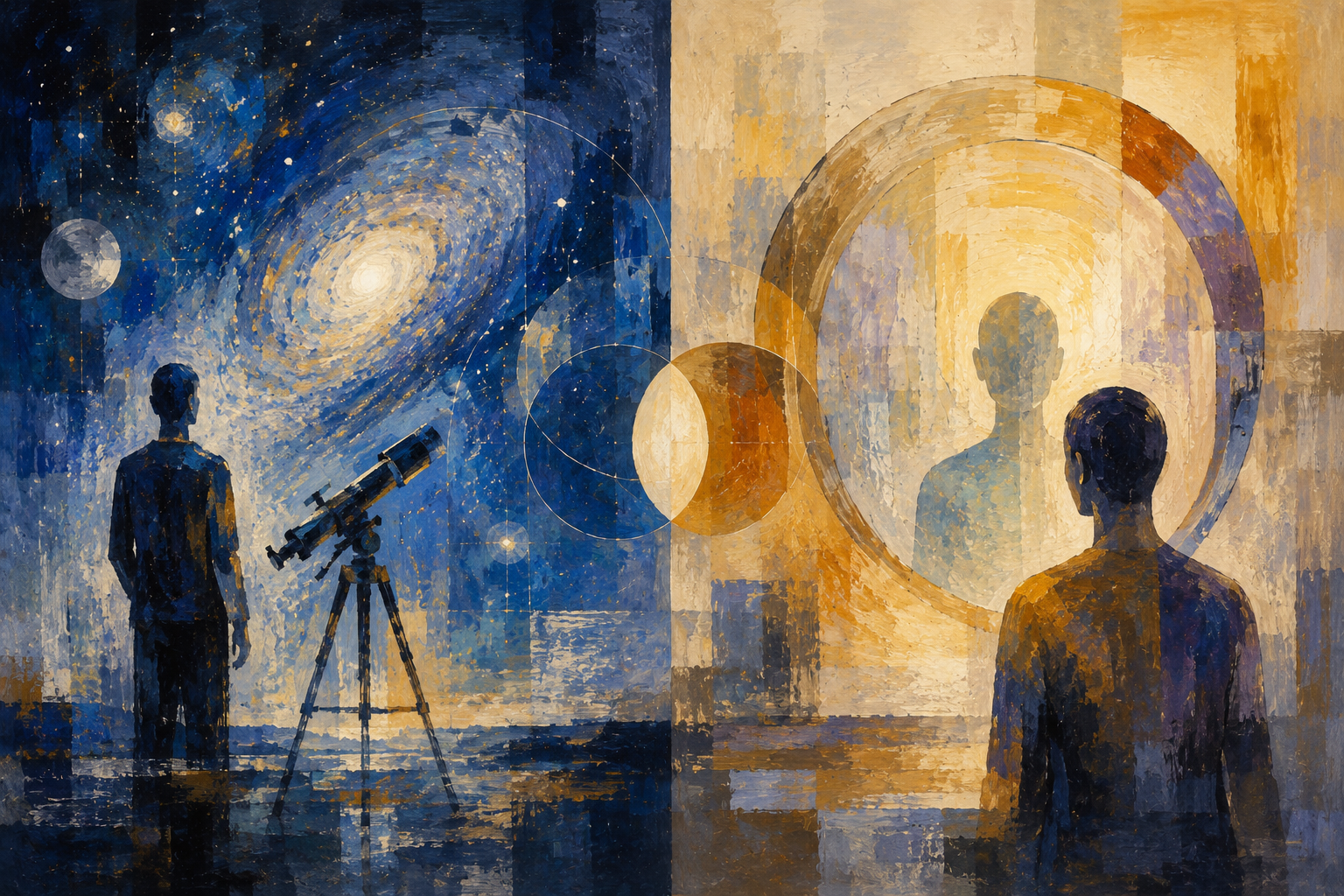
In the scientific quest our understanding is additive in nature. What Newton did in a whole lifetime we can now learn in two or three years in college and build on it to discover further. The knowledge of what people have done before helps us to learn that quickly and discover beyond that. In the spiritual quest, knowledge is not so helpful. In fact, it can even be a hindrance if one gets attached to it. What the Buddha discovered and stated, I can read and come upon the knowledge of Buddhism, including all that has been said about the Buddha. All that knowledge would make me a Professor of Buddhist philosophy, but the Professor of Buddhist philosophy is not the Buddha! One cannot come upon the order that was there in the consciousness of the Buddha merely through knowledge. So Buddha’s student has to observe all over again and rediscover what the Buddha discovered in order to come upon that order in his own consciousness. One cannot simply learn it like knowledge. One requires something beyond knowledge, namely an insight into the truth. Without that insight, which is a direct perception of the truth, there is no alteration of our consciousness. In the field of science also an insight is essential but only for the first person who discovers the truth. If Einstein did not have a deep insight into the questions of space, time, matter and energy, his mind could not have come upon a totally new perception which was not there in classical physics. His mind had all the knowledge of classical physics, but it must have also had a certain amount of freedom from the known in order to have an insight into a truth which was then totally outside the field of the known.
All great scientific discoveries are results of such insights. But after the scientist has had the insight and come upon a truth, he puts it in the form of an equation, deduces it and verifies it logically. Thereafter, it is taught not through insight but through logic. Science is not taught to students the way it actually happened, it is taught through rational, logical ways. Knowledge and logic have a sequence and learning that sequence is enough since it works, even though one may not have the insight of the original discoverer! In the spiritual quest, if one does not have an insight one only has ashes.
The Role of Authority
So there are several intrinsic difficulties with the spiritual quest. Moreover, it seems to me that we have not been intelligent about the spiritual quest. Look at what mankind has done. Just as there have been great scientists like Einstein, Newton, Galileo, Darwin, and so on, there have also been great spiritual teachers. People respect those great spiritual teachers because they came upon a certain state of consciousness, which was one of love and compassion, a universal consciousness that was not divided from the rest of the world. But what did their followers do? The followers said, “This man is our guru, our teacher, our savior, our leader, so let us worship him”. They took his words and propagated them. They evolved a system, an organization that became the church. The followers did not come upon the truth; they were satisfied with propagating the word. Suppose the scientists had done the same, if they had built a temple to Newton and said, “We are Newtonians, Newton is our leader, whatever Newton said alone is true, and we are going to propagate it” and another group of scientists did that for Einstein and said, “We are Einsteinians”, would we have called them scientists? We would have said: “You have to learn science, study and discover the order in nature, come upon the understanding and knowledge of science, only then you are a scientist”. But in the field of spirituality, we have been very gullible. If a man wears a certain type of dress, goes and does a certain ritual, lights the lamp in a certain way, and so on, we accept him as a holy man. We have lost sight of the fact that this is also a quest, an inquiry. Unless a human being comes upon order in his consciousness, which is the essence of virtue, he is not a religious man. It has nothing to do with rituals, with the dress we wear, with the words we utter, or the books we read. It has nothing to do with some ability or knowledge we have in our heads, either.
Belief
The other factor that has very seriously bogged down the religious quest is belief. What does belief mean to a person who is in quest of truth? We have to regard it the same way as a scientist regards a theory. The theory is not the truth, the model is not reality. We have to do experiments to find out what is true. But when we have a belief, we are merely accepting something without evidence, which has little value. Rejecting an idea quickly also has no value. Acceptance is as false as rejection. It is only when we listen and consider, and neither quickly accept nor reject, but live with the question and explore it through our own observations, that we may get some truth out of it. The religious quest has not gone far because we have interpreted it to mean belief and the practice of certain rituals, and so on. We think it will give us peace of mind, which will bring us to something divine. That is an illusion. Worship may give us a certain peace of mind temporarily, but for the same reason for which the mind was disturbed yesterday, it will be disturbed tomorrow because the same causes are still operative. If the problems do not dissolve at the source, the cause remains, and the effect is bound to follow.
The Practice of a Moral Code
The third thing that institutionalized religions gave was a moral code — what is right, what is wrong, what to do, and what not to do. We must examine whether one can come upon virtue through the practice of premeditated virtuous actions. A particular action, when repeated, soon becomes a habit, and one can feel virtuous without having come upon virtue. That is a serious difficulty of the spiritual quest. If I am aggressive, violent, hateful, can I practice non-violence? I project an idea that non-violence means not hitting another person, so I hold myself back. I get angry, I feel like hitting the other person, but I don’t hit, saying I am practicing non-violence. But in my consciousness, there is still hatred, there is still aggression. I have merely prevented the outer manifestation. Surely, there is non-violence only when there is the ending of violence in the consciousness. As long as I am inwardly violent and I think I am practicing non-violence, it is only control. And self-control is something totally different from the ending of violence. All those religious commandments only lead to self-control. Self-control may be necessary, but it does not alter the consciousness within us. Self-control will never bring understanding and the end of violence within our consciousness.
Virtue as Order in Consciousness
Virtue is a state of mind. There is virtue only when disorder ends. Violence, fear, jealousy, and possessiveness are all a part of the disorder in our consciousness. One cannot impose order on disorder through discipline. If we do that, it is still part of disorder; it is only control, and that control is still part of the disorder. The need to impose order on oneself arises only when there is disorder in the consciousness. Therefore, the imposed order is really disorder. Suppression is violence with oneself; so the violence is still there, and nothing changes inwardly. Of course, the external action also matters, and to that extent, self-control may be necessary, but it changes nothing inwardly. We are still in conflict when we are only controlling. If we are suppressing, fighting with ourselves, then what is controlled and overcome on one day will have to be controlled every day, which means all of life becomes a battlefield. It is not a religious life to be constantly in battle with oneself! All disorder has a cause, and so long as the cause exists, the disorder will exist. So the religious quest is an inquiry into the causes of disorder in our mind. Just as a scientist cleans his instruments and lenses to ensure that they do not distort his observation of facts, the religious man has to eliminate the disorder in his mind since that is the instrument with which he observes. Disorder is caused by illusions, and the illusions end only with the direct perception of what is true and what is false. The spiritual quest is therefore a quest for self-knowledge, and virtue is a by-product of that quest.
The Religious Mind
Such an approach to spirituality is independent of any denomination and is therefore universal, like science. Just as there is no such thing as Indian science or American science, there is also only one religious mind — the mind that has come upon love, compassion, peace, and harmony. It is not a Hindu mind, a Christian mind, or a Buddhist mind. These divisions arise because we have equated belief with religion. The truly religious mind is in quest of truth, which it posits as the unknown. Science also posits the truth as the unknown and continually refines its models in trying to approximate it. It is our illusions that divide us into separate religious communities. The different institutionalized religions are historical by-products of man’s spiritual quest and need to be distinguished from the quest itself. Similarly, we need to distinguish between science and its by-product, which is technology. Science is the quest for truth, whereas technology is a by-product resulting from man’s desire for power and comfort. The unbridled use of power has created all the ecological problems the world is facing today. They are the result of man’s greed and selfishness, not of the scientific quest itself. Humanity needs to continue the scientific and spiritual quests without becoming too entangled in their by-products.
Two Complimentary Quests
Actually, both the spiritual and scientific quests are two complementary inquiries into reality. Any feeling of antagonism between them is a product of a narrow vision. Science deals with what is measurable; religion is the quest for discovering and understanding the immeasurable. A scientist is not intelligent if he denies the existence of the immeasurable. There is nothing that is anti-science but there is a lot that is beyond science. The two quests have to go hand in hand. We not only need to have an understanding of the laws that govern the phenomena occurring in the external world around us but also we need to discover order and harmony in our consciousness. Human understanding is incomplete unless it covers both aspects of reality: matter as well as consciousness. Indeed the division between the scientific and spiritual quests is itself the creation of the human mind. Reality is one undivided whole which includes both matter and consciousness. Our thoughts, being limited by our experience, divide the external world from the inner world of our consciousness, in much the same way as our mind divides time from space though they are both two aspects of a single continuum.
Both the scientist and the religious man need to be acutely aware of the limitations of the human mind and to transcend them if they aspire to have a holistic perception of reality. Education needs to address the creation of an inquiring mind that is both scientific and religious if we are to avert the crisis facing modern civilization. To discard all spiritual inquiry along with all religious beliefs in the name of secularism is like throwing away the baby with the bathwater.
Further Reading
- Krishnamurti: Start Here, en. Available at: https://kfoundation.org/start/. Accessed June 2, 2026.
- R. Ravindra, Science and the Sacred. Wheaton, IL: Quest Books, September 2002.
- J. Krishnamurti and D. Bohm, The Ending of Time. HarperSanFrancisco, October 2014.
- D. Bohm, Science and Spirituality, lecture delivered as a public lecture on October 23, 1990, addressing what Bohm considered the essential relationship between science and spirituality, wholeness, culture, and the role of dialogue. This version of Bohm’s talk was reissued in honor of the 100th anniversary of his birth (December 20, 1917). See the essay at: https://share.google/W3QFcMIAcBN0AXr9b .
- Jiddu Krishnamurti (1895–1986) was an Indian philosopher and speaker who spent decades questioning the foundations of religious authority, psychological conditioning, and organized belief. Rejecting all labels — guru, spiritual teacher, mystic — he insisted that truth could not be handed down through tradition but had to be discovered by each person through direct inquiry. His talks and writings, which span several decades and dozens of volumes, continue to draw readers from both the sciences and the humanities. ↩︎