



Prologue
Food is never experienced by taste alone. A meal unfolds through color, aroma, texture, memory, emotion, and — just as importantly — the people around us. My research asks how these sensory and social signals meet in the brain: can what we taste subtly change what we see in another person’s face? India, where food and social connection are so closely intertwined, offers an especially vivid setting in which to explore this question.
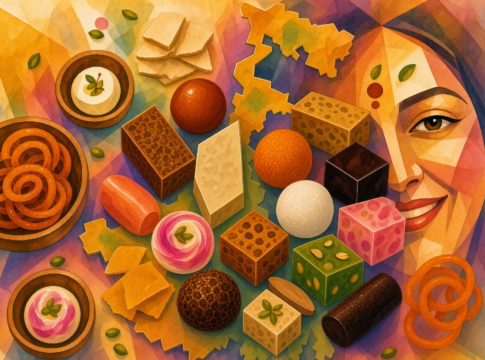
In India, sweetness is rarely just a taste. It is woven into hospitality, celebration, gratitude, and human connection. This is especially visible in Bengal, a region of eastern India renowned for its tradition of mishti — the Bengali word for sweets and sweetness. Mishti includes delicacies such as sandesh (a soft fresh-cheese confection), rasgulla (spongy cheese balls in sugar syrup), and mishti doi (sweetened fermented yogurt). Offered to welcome guests, celebrate festivals and good news, or simply share affection, these sweets carry memories, relationships, and a sense of occasion.1
This cultural affection for sweetness raises an intriguing scientific question. When a sweet taste accompanies a conversation, does it merely make the moment more enjoyable — or could it also change the way we see the person in front of us? More specifically: can a sweet taste help us notice a smile?
Our research suggests that the answer may be yes, although in a subtle and carefully defined sense. Sweetness does not manufacture happiness, guarantee friendship, or turn a difficult negotiation into an easy agreement. But it may tune the perceptual system, making the brain more sensitive to positive facial expressions that are already there.
A Conversation Between the Mouth and the Eyes
We often imagine the senses as separate channels. The tongue tastes, the eyes see, the nose smells, and the ears hear. Yet this division is more convenient than biologically accurate. In everyday life, the brain must combine signals arriving from different senses into a single, coherent interpretation of the world.
A meal is an obvious example. What we call flavor is assembled from taste, aroma, texture, temperature, color, memory, and expectation. Social encounters are also multi-sensory. While talking across a table, we do not process words alone. We read a fleeting smile, notice a slight frown, hear a change in tone, smell coffee or food, and experience whatever is currently in our own mouth. All of these signals arrive in the same brain at almost the same moment.
This means that eating and talking are not two independent activities. The sensory state created by food or drink may become part of the context in which we interpret another person. The mouth and the eyes, in other words, may be engaged in a quiet conversation of their own.
What Happens When We Taste Sweetness?
To examine this possibility, we studied how basic tastes influence the detection of emotional facial expressions. Participants experienced a sweet or sour taste while viewing faces expressing different emotions. We were particularly interested in whether a taste would make people more sensitive to a facial expression with a matching emotional quality.
The pattern was striking. As reported in our recent study[1], sweet tastes enhanced the detection of pleasant facial expressions — small but socially important signals that indicate another person is pleased, friendly, or receptive. Sour tastes produced a different effect: they facilitated the faster recognition of disgusted faces.
This is known as an emotion-congruency effect. Sweetness is commonly associated with pleasantness, reward, and positive social meaning; sourness is more closely linked to aversion and rejection. The taste does not replace the information in the face. Rather, it appears to prepare the perceptual system to give greater priority to emotionally compatible information.
The Effect Begins Earlier Than We Expected
The behavioral finding was only part of the story. Using electrophysiological and brain-imaging methods, we also examined when and where this interaction takes place.
Scientists have often assumed that information from taste and vision is combined mainly in higher-level brain regions involved in emotion and decision-making. Our findings, however, suggest that the conversation between the mouth and the eyes begins much earlier.
Our earlier electrophysiological study showed that sweet and sour tastes can influence the brain’s response to emotional faces within the early stages of visual processing [2]. Our more recent fMRI study supported this finding by showing taste-related changes in the primary visual cortex, one of the first brain regions to process what the eyes see [1].
The brain is therefore not simply comparing a finished taste with a finished image of a face. It appears to coordinate the senses while perception is still being constructed. Before we consciously decide that someone is smiling, what we taste may already have influenced which visual signals receive priority.

Mishti, Smiles, and the Social Table
This is where the science returns to the Indian table. Mishti is not merely sugar delivered to the tongue. It is often presented in a context of welcome, generosity, celebration, and shared pleasure. Those cultural meanings are learned over many years, and they give sweetness a rich emotional background.
Imagine meeting a colleague over coffee, sharing sweets with friends, or sitting down for a business discussion after a warm welcome. The taste of something sweet cannot tell you whether the other person agrees with you. It cannot create trust by itself. Yet it may make the brain a little more ready to register a genuine smile, a moment of warmth, or a positive response that might otherwise pass unnoticed.
This possibility is especially relevant because facial expressions are brief and easily missed. A smile may appear for only a moment before the conversation moves on. Social understanding often depends on detecting such small signals at the right time. If taste changes the sensitivity of the perceptual system, then the food and drink on the table are not merely background decorations. They become part of the sensory architecture of the encounter.
Does this mean that societies with strong traditions of sweets necessarily see more happiness? Science cannot make that claim. Culture, relationships, expectations, health, and many other factors shape emotional life. Nor should the finding be interpreted as advice to consume large amounts of sugar. The effect concerns sensory experience, not a prescription for excessive sweetness. A small taste, aroma, or culturally meaningful serving may be sufficient to create the relevant context.
Should You Order Dessert Before a Difficult Conversation?
Perhaps — but with realistic expectations. A sweet taste will not rescue a poor argument, settle a contract, or guarantee a successful date. It may, however, gently tune attention toward positive social cues. That is a much smaller claim, but also a fascinating one.
The practical lesson is not that we can manipulate people through food. It is that every conversation has a sensory setting. Lighting, sound, aroma, taste, bodily comfort, and emotional expectation all participate in the way people perceive one another. Choosing food and drink thoughtfully may help create an atmosphere in which warmth is more noticeable and positive signals are less likely to be missed.
So the next time mishti is offered at a celebration, a meeting, or a friendly visit, consider what is happening beyond the pleasure on the tongue. The sweet taste may be joining a much larger neural conversation — linking the mouth, the eyes, emotion, memory, and culture.
Sweetness does not put a smile on another person’s face. But it may help the brain notice the smile that is already there.
From the Editors’ Desk
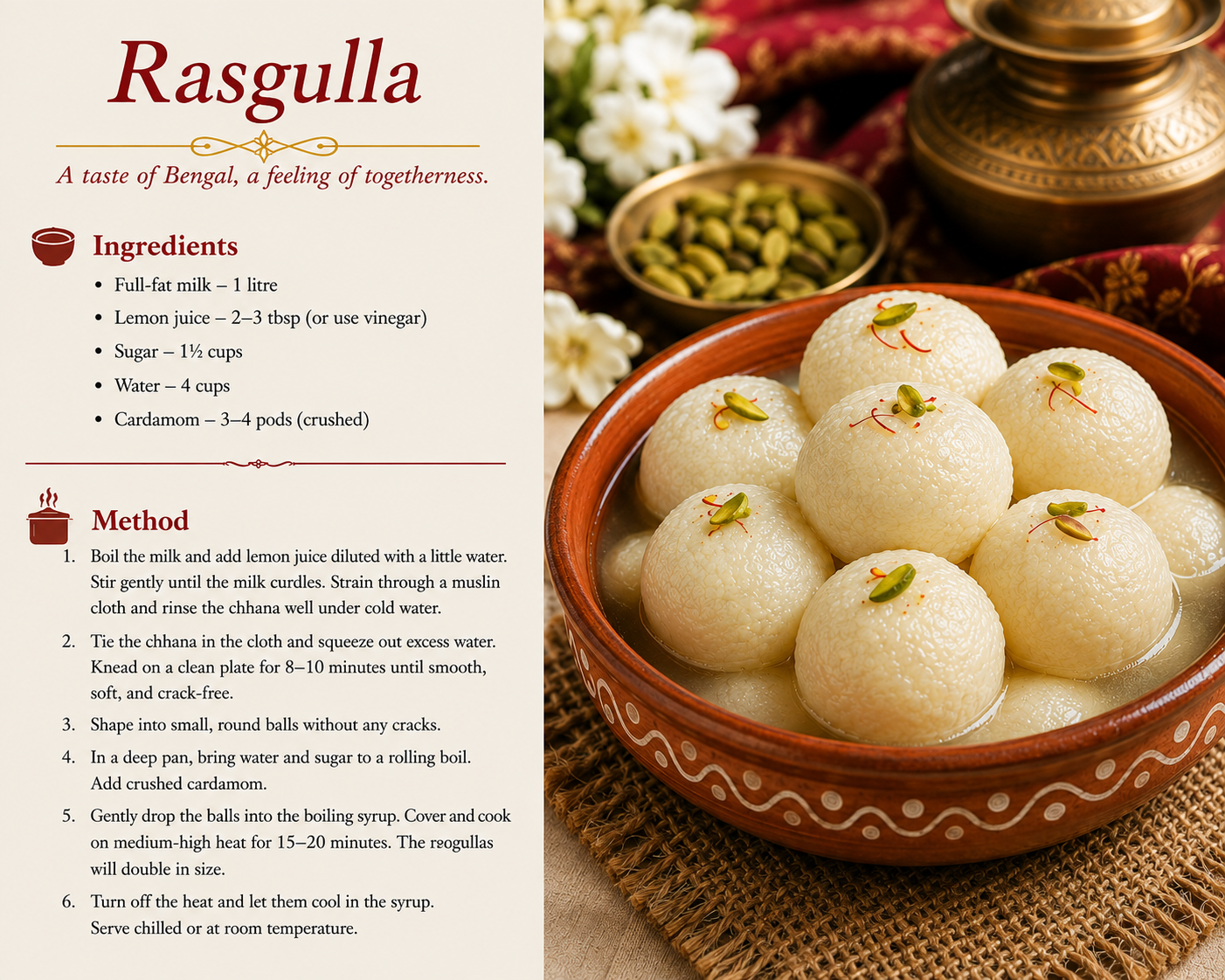
What better way to end than with a bite of sweetness? Enter the rasgulla, the beloved misti whose syrupy, cloud-like softness evokes pure nostalgia, devotion, and fierce regional pride. Positioned at the heart of Bengal and Odisha’s celebrated confectionery traditions, it does more than satisfy a sweet tooth; it embodies the cultural soul of both states.
The sweet even sparked a legendary tug-of-war over its origins, with Odisha tracing its roots to 12th-century Jagannath temple offerings, and West Bengal honoring Kolkata confectioner Nobin Chandra Das for perfecting the modern, spongy rosogolla in 1868. Ultimately, a diplomatic verdict was offered, granting Geographical Indication tags to both Banglar Rosogolla (2017) and Odisha Rasagola (2019), affirming a heritage both shared and uniquely distinct.
The recipe below brings our readers the iconic Bengali variation: ultra-light, impossibly spongy, and delicately sweet.
1 Bengal’s sweet-making culture extends across both West Bengal, India, and Bangladesh. In Bangladesh, mishti likewise plays an important role in hospitality and celebrations, alongside distinctive local traditions such as Bogura doi and Porabari chamcham. ↩
References
[1] Chen et al., “Tasting emotions: An in-depth fMRI study exploring gustatory and visual cross-modal associations across various spatio-temporal regions of the human brain,” NeuroImage, 320, 121468 (2025). https://doi.org/10.1016/j.neuroimage.2025.121468 .
[2] Liang et al., “Affective face processing modified by different tastes,” Frontiers in Psychology, 12, 644704 (2021). https://doi.org/10.3389/fpsyg.2021.644704 .