Abhijit (Abhy) Gupta is a retired IT professional whose career spanned from firmware development to cybersecurity. He holds an MBA from the City University of New York and B.Tech and M.Tech degrees in Electrical Engineering from the Indian Institutes of Technology. Today, he enjoys exploring classic and visceral films, traveling, and restoring and maintaining his vintage model train system. He has a passion for revisiting solutions to classic problems in engineering, physics, and mathematics.
Written in collaboration with the Curiosità editorial team.
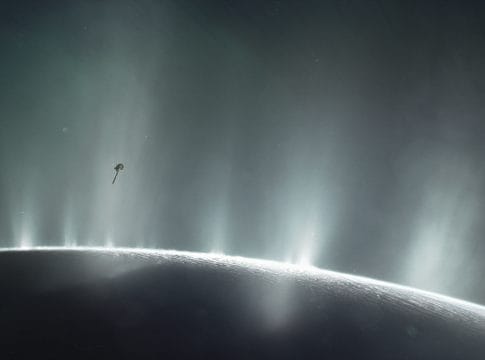
This article is presented in two parts because it explores two complementary aspects of the same story. Part I examines the scientific motivation for travelling to the outer Solar System — particularly the discovery of ocean worlds such as Enceladus and Europa that may harbor the conditions necessary for life. Part II shifts focus to the physics and engineering that make such exploration possible, explaining how gravity-assist maneuvers allow spacecraft to traverse immense interplanetary distances with remarkable efficiency.
Abhijit (Abhy) Gupta is a retired IT professional whose career spanned from firmware development to cybersecurity. He holds an MBA from the City University of New York and B.Tech and M.Tech degrees in Electrical Engineering from the Indian Institutes of Technology. Today, he enjoys exploring classic and visceral films, traveling, and restoring and maintaining his vintage model train system. He has a passion for revisiting solutions to classic problems in engineering, physics, and mathematics.
Written in collaboration with the Curiosità editorial team.
Abhy, I really like the intentional structure you’ve gone with here. Splitting the piece into two parts doesn’t just make it easier to read—it actually mirrors the dual nature of space exploration itself. On one side, there’s that deep scientific curiosity pushing us outward, and on the other, the sheer ingenuity it takes to get us there. Framing it this way gives both aspects room to breathe, while still making it clear they’re tightly linked.
Part I, with its focus on ocean worlds like Enceladus and Europa, really taps into that big, irresistible question: could life exist beyond Earth? By anchoring the narrative in recent discoveries and growing evidence for subsurface oceans, you’re doing more than just laying out facts—you’re pulling the reader into one of the most exciting frontiers in modern science. And the way you build a sense of wonder and stakes works especially well—these aren’t just far-off moons, they’re potential habitats that could fundamentally change how we think about life in the universe.
Then in Part II, the shift into physics and engineering feels smooth and well-earned. What stands out is how you take material that could easily feel dry or overly technical and give it a kind of elegance. Gravity-assist maneuvers, for instance, are often explained in strictly mechanical terms, but you bring out their conceptual beauty—using the motion of planets almost like cosmic stepping stones. It really drives home the idea that exploration isn’t just about ambition; it’s about working with the laws of nature, not against them.
What ties both sections together nicely is the underlying thread that discovery and capability evolve side by side. We dream because we learn, and we reach because we build. The science gives the journey its purpose, and the physics makes it possible. By separating these strands and then subtly weaving them back together, you help the reader see the bigger picture without losing clarity.
All in all, the piece takes the reader from inspiration to implementation in a way that feels natural, not overwhelming. And it lands on a strong, resonant idea—that the search for life and the mastery of space travel aren’t separate pursuits, but two expressions of the same human drive.
Thanks, Sanat, for your perspective, observations and encouragement. We want to raise science awareness and for our readers to understand the steps and processes that scientists undertake to address our larger questions. I am looking forward to others posing questions and topics for future consideration.
Hi Abhy:
So basically… are we spacefaring geniuses, or just really good at hitchhiking off Jupiter on the way to places like Europa and Enceladus? 😄
At some point, do we graduate from these cosmic slingshots to something more like “press button, go fast,” or are we always going to be that clever species that saves fuel by borrowing a little momentum from the big guys?
Also makes me wonder—did we just get ridiculously lucky with how the solar system is laid out? Like, if the planets weren’t lined up so conveniently, would we still be talking about ocean worlds today, or would they be stuck in the “cool idea, shame we can’t get there” category?
And speaking of lucky timing, the whole Voyager program situation feels like catching the last train of the night—a once-in-a-very-long-while “cosmic highway.” Are we still planning missions around these rare alignments, or have we gotten better at making our own luck?
On a more philosophical note: are gravity assists basically the ultimate life lesson? Don’t brute-force it—just be in the right place at the right time and let physics do the heavy lifting.
And one thing I’ve always been curious about—when you stack multiple flybys, how do scientists decide between “save fuel” and “maybe don’t take 30 years to get there,” especially if we’re chasing signs of life?
Feels like space exploration is part rocket science, part celestial pool trick… and I’m not entirely sure which part we’re better at.




Abhy, I really like the intentional structure you’ve gone with here. Splitting the piece into two parts doesn’t just make it easier to read—it actually mirrors the dual nature of space exploration itself. On one side, there’s that deep scientific curiosity pushing us outward, and on the other, the sheer ingenuity it takes to get us there. Framing it this way gives both aspects room to breathe, while still making it clear they’re tightly linked.
Part I, with its focus on ocean worlds like Enceladus and Europa, really taps into that big, irresistible question: could life exist beyond Earth? By anchoring the narrative in recent discoveries and growing evidence for subsurface oceans, you’re doing more than just laying out facts—you’re pulling the reader into one of the most exciting frontiers in modern science. And the way you build a sense of wonder and stakes works especially well—these aren’t just far-off moons, they’re potential habitats that could fundamentally change how we think about life in the universe.
Then in Part II, the shift into physics and engineering feels smooth and well-earned. What stands out is how you take material that could easily feel dry or overly technical and give it a kind of elegance. Gravity-assist maneuvers, for instance, are often explained in strictly mechanical terms, but you bring out their conceptual beauty—using the motion of planets almost like cosmic stepping stones. It really drives home the idea that exploration isn’t just about ambition; it’s about working with the laws of nature, not against them.
What ties both sections together nicely is the underlying thread that discovery and capability evolve side by side. We dream because we learn, and we reach because we build. The science gives the journey its purpose, and the physics makes it possible. By separating these strands and then subtly weaving them back together, you help the reader see the bigger picture without losing clarity.
All in all, the piece takes the reader from inspiration to implementation in a way that feels natural, not overwhelming. And it lands on a strong, resonant idea—that the search for life and the mastery of space travel aren’t separate pursuits, but two expressions of the same human drive.
Thanks, Sanat, for your perspective, observations and encouragement. We want to raise science awareness and for our readers to understand the steps and processes that scientists undertake to address our larger questions. I am looking forward to others posing questions and topics for future consideration.
Nice article; interesting topic; well organized and well written.
Enjoyed it…thank you.
Hi Abhy:
So basically… are we spacefaring geniuses, or just really good at hitchhiking off Jupiter on the way to places like Europa and Enceladus? 😄
At some point, do we graduate from these cosmic slingshots to something more like “press button, go fast,” or are we always going to be that clever species that saves fuel by borrowing a little momentum from the big guys?
Also makes me wonder—did we just get ridiculously lucky with how the solar system is laid out? Like, if the planets weren’t lined up so conveniently, would we still be talking about ocean worlds today, or would they be stuck in the “cool idea, shame we can’t get there” category?
And speaking of lucky timing, the whole Voyager program situation feels like catching the last train of the night—a once-in-a-very-long-while “cosmic highway.” Are we still planning missions around these rare alignments, or have we gotten better at making our own luck?
On a more philosophical note: are gravity assists basically the ultimate life lesson? Don’t brute-force it—just be in the right place at the right time and let physics do the heavy lifting.
And one thing I’ve always been curious about—when you stack multiple flybys, how do scientists decide between “save fuel” and “maybe don’t take 30 years to get there,” especially if we’re chasing signs of life?
Feels like space exploration is part rocket science, part celestial pool trick… and I’m not entirely sure which part we’re better at.