



Prologue
Trees are the Earth’s endless effort to speak to the listening heaven.
— Rabindranath Tagore
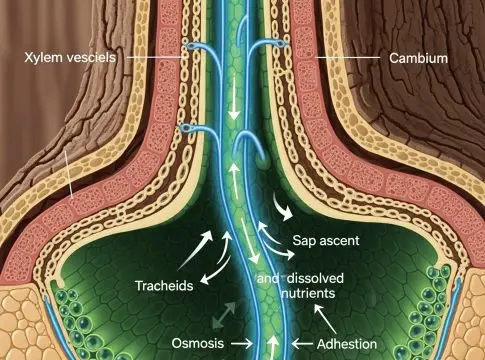
It would be fair to say that there is a silent medium of the tree speech, one related to transpired water. Tall trees are remarkable anti-gravity devices, capable of silently lifting hundreds of kilograms of water a day from their roots to their leaves — sometimes over a hundred metres — without expending any significant metabolic energy. Almost all of that water is released as vapour into the listening atmosphere.
Trees have no pump. Why do they do it? How do they do it?
The answer to the why question is well-known. The most important chemical reaction in the plant kingdom is photosynthesis taking place in leaves. Here sunlight, water and carbon dioxide taken from the atmosphere combine to form sugars, the building-blocks of plants, which are distributed through channels called phloem to all parts of the plant for growth. Yet only about a few percent of the water taken from the soil by trees is used for the purposes of photosynthesis and the growth of cells. All the rest is evaporated into the atmosphere. This seeming wastefulness is the price paid by trees — and plants generally — in exploiting a lifting process that is passive, the energy source being the sun.
It is the how question that this article principally addresses.
The priming process
There are two quite different processes involved in the rise of sap in trees. The first is what might be called the priming of trees. It makes water available to the leaves so that the second process, transpiration, leads to daytime upward flow of sap involving water likewise drawn from the soil.
It is the second process that is passive in the above sense and is usually referred to in the ascent of sap. The first, less celebrated priming process deserves a few words now.
If evaporation of sap water from the leaves is the spur to the transpirational pull of water from the roots, this can only happen if sap is available to the leaves in the first place. The priming of trees in this sense is a direct result of the growth process in trees. Plant cell growth requires elongation of the cell, and this comes about through the osmotic intake of water into the cell. Mature xylem cells, which undergo programmed death, provide the rigid tubes through which sap can rise from the roots to the leaves. These tubes are born full of water drawn up from the roots — all the way to the leaves. The osmotically-driven process of growth requires metabolic energy provided by respiration taking place in the tree. The nature of the priming mechanism was only fully understood after the birth of what is now called the Cohesion-Tension (CT) theory related to the second, transpiration process, to which we now turn.
Some Early History
The origins of our current understanding of the physics behind the marvel of transpiration goes back to 1895. In that year the first versions of the CT theory were independently formulated by scientists in Dublin and Heidelberg. The physics involved has to do with capillarity, osmosis and fluid mechanics, along with the remarkable properties of that most anomalous of liquids, water. The CT theory and its ongoing development represent one of the unsung triumphs of modern science. Before we go into detail about the how question, we need to address another. Why did the theory take so long to appear?
From ancient times, thinkers with a scientific bent have wondered how plants grow.
Where do their nutrients come from? On a number of occasions over the centuries, thinkers familiar with potted plants have wondered why the mass of the earth in the pot does not seem to diminish while the plant grows. The only extra ingredients for growth are sunlight and water. This led to the view held by some that it must be water that is transmuting into plant tissue — a view consistent with the pre-Socratic Greek thinker Thales of Miletus who regarded water is the fundamental Element. In tune with the emerging scientific revolution, actual experiments weighing the soil in growing potted plants were finally performed by Johannes Baptista van Helmont (a contemporary of Galileo living in what is now Belgium) probably in the 1630s and by Robert Boyle in England in the 1640s. No loss of soil mass was discerned.
Both Issac Newton in England and René Descartes in France both made stabs at a mechanistic understanding of water transport and growth in plants. But it was the English polymath parson, Stephen Hales, who made the first major breakthrough.
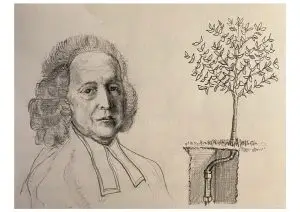
In 1727 he published an account of numerous careful experiments he had performed on plants. He established that the air must be providing at least some of their food, and thus anticipating the rudiments of photosynthesis. Although not the first to recognise that sap in plants does not circulate like blood in our bodies, Hales realised that water perspired from leaves is lifted by plants from the soil through the stem and branches without the action of a heart-like pump.
Hales was a follower of Isaac Newton, inspired by his approach to experimental natural philosophy. In particular he shared Newton’s interest in the mysterious phenomenon of capillary rise of water and other liquids in thin vertical tubes, and surmised that capillarity must be at work in the rise of sap in plants. He came close to discovering the rudiments of the CT theory, but for two main errors. He thought water transport in plant stems involved a mixture of liquid and vapour, and he imagined that capillarity takes place in the hollow (xylem) conduits inside the stem of the plant. We now know that xylem conduits, although of microscopic dimensions, have diameters that are too wide to lift water more than a few metres at best, so capillarity in this sense cannot be doing the work in tall trees.
Another counterintuitive fact was discovered in the 17th century, only to be rediscovered several times over by independent researchers in the following century. Certain liquids like water and mercury can be stretched, or prepared in a tensile state (negative pressure). Strangely, this possibility was known – and puzzled over by scientists like Robert Boyle – well before the existence of surface tension was discovered in the latter half of the eighteenth century. But by the end of that century, scientists were more familiar with surface tension than with the phenomenon of bulk liquids under tension. Another great English polymath, Thomas Young, was able to use the notion of surface tension to provide in 1804 the first systematic account of capillary pressure as well as proof of the well-known fact that the height of a vertical capillary column at equilibrium is inversely proportional to the diameter of the capillary. At the same time, the great French mathematician Pierre-Simon Laplace independently hit on the same ideas, but he provided the equations that were lacking in Young’s writings. As one commentator put it, with Young one is reading a natural philosopher and with Laplace a modern mathematical physicist.
More History
So several of the important elements in the CT were in the air by the beginning of the nineteenth century, but it took until the end of the century before the full theory was concocted. The reasons are complex. It was not until 1891, through the work of the great Polish-German botanist Eduard Strasburger, that convincing evidence was obtained that the rise of sap was not the result of active behaviour of live elements in a tree, and that water forms continuous threads within (at least some) xylem conduits joining roots and leaves. But botanists even then could not agree on a lifting mechanism, partly because the possibility of water under tension was so little known by them: it seemed to occur nowhere in the natural world.
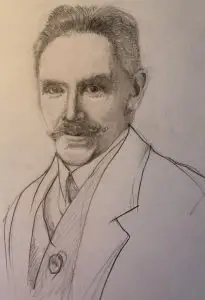
The next breakthrough was made by the Austrian botanist Josef Anton Böhm in 1893, who realised like Hales that transpiration combined with capillary forces are involved in the ascent of sap, but accompanied by the stretching of water in the xylem. However, Bohm could not specify where capillary action is taking place in the plant or tree. This conundrum was finally solved by the two Irishmen mentioned earlier: the botanist Henry H. Dixon (Figure 2) and his somewhat older friend, the physicist and geologist John Joly (Figure 3), both teaching in Trinity College Dublin. (This is an example of how fruitful collaboration can be between different branches of science. Joly was aided in discussions with his earlier mentor, the great Irish physicist George Frances FitzGerald.) Their classic paper was published in 1895, and Dixon published the theory in book form in 1914.

Dixon and Joly realised that a combination of evaporation and capillary action in the leaves during sunlight hours is pulling up continuous threads of sap through the xylem conduits all the way from the roots, the threads being under tension — stretched — in tall trees. When the distinguished botanist Francis Darwin, son of Charles Darwin, first heard of this idea, he said it was like believing in ropes of sand!
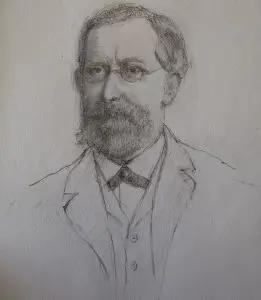
Dixon and Joly were keenly aware that stretched water is not stable. They performed experiments showing why tensile water, even with dissolved air, does not normally boil during transpiration and thereby obstruct the upward transport of water. Largely independently of our Irish heroes, the Russian-born plant scientist Eugen Askenasy (Figure 4) also published very similar ideas in 1895 and 1896, while a professor at the University of Heidelberg.
His important work was apparently never translated into English, although it seems to have been influential amongst some American botanists. Regrettably, it is hard to find detailed discussion of his work in the (surprisingly limited) historical literature on the CT theory.
Development following the pioneers
A great effort has been made by plant scientists since the 1890s to fill out the details and remove obscurities in the early work of the CT theory pioneers. This has taken place through careful experimental and theoretical work. Although today the basic mechanism behind the ascent of sap is closely related to the ideas of Dixon, Joly and Askenasy, there is much more understanding of the science involved — while yet more mysteries have appeared.
The CT theory exploits a number of the weird properties of water, in particular, its cohesiveness. Even though the molecular structure of bulk liquid water is still largely a mystery, the discovery in the twentieth century of hydrogen bonds between water molecules provided a sound basis for the phenomenon of stretched water. It is now understood in principle how threads of water in the xylem can be under tension of up to 100 negative atmospheric pressures in some plants without rupture.
Some of the advances made after the 1890s are related to the physiology of roots, xylem and leaves. A far better picture exists today of their role in sustaining water transport, both from a thermodynamic and mechanical point of view. Mathematical modelling is even being applied to the problem of how water in both liquid and vapour form moves inside the leaves before release of water vapour into the atmosphere takes place through tiny openings called stomata. But unresolved issues remain.
There is still debate about the exact way water moves through roots and whether xylem in roots and stems is inert or local processes exist that can regulate transpiration flow. There have been advances in the physics involved in capillarity and osmosis, but recently, questions have arisen concerning the extent to which capillarity, in the form understood by the pioneers, is actually what restores water lost from evaporation during the transpiration process. Further questions have been posed whether the remarkable changes in the behaviour of water when confined to nano-scale spaces might be relevant in understanding the behaviour of sap in the pores in cell walls in leaves during transpiration.
A notable development has been the discovery that trees are elastic. They can store water in the sapwood and release it into the xylem at the onset of transpiration in the morning and so help maintain photosynthesis in the leaves. Several processes are at work in creating such a capacitance function, a prominent one being capillary action in the tapered tips of air-filled wood fibres.
Perhaps the biggest lingering mystery concerns the vulnerability of trees, i.e. their susceptibility to cavitation, or the rupture of the flow of sap through the xylem due to air suddenly expanding into its conduits. Cavitation does take place, but not enough to dramatically halt transpiration except in periods of severe water stress such as drought. Many issues remain to be explored regarding the processes leading to cavitation and how it is both contained and repaired in trees. In the 1990s, evidence seemed to be accumulating that xylem conduits can undergo cavitation and repair on a routine, if not daily, basis — even during transpiration! But in the last decade or so, doubts have arisen over the reliability of the hydraulic measurements involved, in one case related to a forgotten warning made by Dixon in 1914! There is also the uncomfortable circumstance that no consensus exists as to the possible mechanism behind this frequent cavitation and repair process. So calls have been made for a wider review of experimental evidence related to tree vulnerability. The issue is clearly highly relevant to ongoing attempts to predict the effects of global warming on trees and forests.
All of these developments are a testament to the evolving nature of the CT theory. It still poses challenges to the plant scientists in intriguing ways. Even the methodology of the theory has undergone changes, principally through the development of a more phenomenological approach, dating back to the late 1940s, involving the soil-plant-atmosphere continuum. It is based on an analogy with Ohm’s law for electrical circuits and led to significant progress in determining relative hydraulic resistances of elements in the continuum and the regulatory role of stomata in the leaves. In the late 1960s and 1970s, a new paradigm of hydraulic architecture emerged which combined principles of this approach with the more fine-grained insights in the traditional CT theory.
Final Remarks
It is hard to disagree with the late plant scientist Steven Vogel, who wrote in 2012:
Nothing in physical biology makes a better story than the tale of the ascent of water — mechanically counterintuitive, historically curious, structurally specialized, globally critical
The CT theory has, over the years, faced its fair share of skepticism, criticism, and the challenge of rival theories. It remains a work in progress. But no rival theory has been as successful in accounting for the phenomena associated with the rise of sap in trees. One of the leading figures in the modern development of the CT theory, Melvin Tyree, wrote in 2003:
I can think of no other botanical theory that has engendered more incredulity among physical scientists and animal physiologists than the CT theory, because it requires us to suppose that water is transported in a metastable state.
And yet it moves, as Galileo might say.
Further details regarding the physics involved in the CT theory, as well as extensive references to the literature on the theory and it history, can be found in this paper: H R Brown and A P Sutton (2025), Trees Suck. Notes on the physics of transpiration in trees, Progress in Biophysics and Molecular Biology, 195, 71-86 [1]. The present author is completing a popular book on the subject for Oxford University Press; the title (inspired by Tagore) is likely to be Between Earth and Heaven: The physics and future of trees.
References
[1] H. R. Brown and A. P. Sutton, “Trees suck. Notes on the physics of transpiration in trees,” Progress in Biophysics and Molecular Biology, vol. 195, pp. 71–86, 2025, issn: 0079-6107. DOI: http://https : / / doi . org / 10 . 1016 / j . pbiomolbio . 2024 .12.002. [Online].