



Symmetry and Its Violation: A Dialogue with C. N. Yang
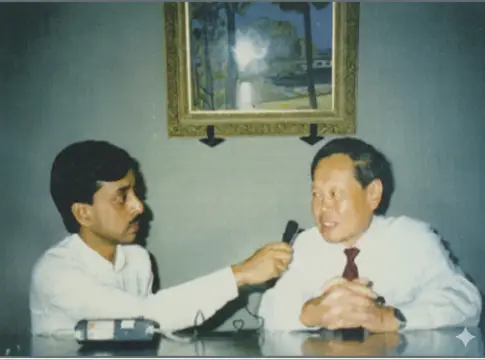
The present article draws upon a series of conversations I had with Professor C. N. Yang during the International Symposium on Foundations of Quantum Mechanics in the light of New Technology, held in September 1986 in Tokyo, Japan, organized by the Central Research Laboratory, Hitachi Ltd. At that time, Professor Yang held the Albert Einstein Professorship at the State University of New York at Stony Brook and served concurrently as Director of the Institute of Theoretical Physics. Our discussions, carried out in an atmosphere of intellectual generosity and candour, offered a rare opportunity to engage with one of the foremost architects of modern theoretical physics.
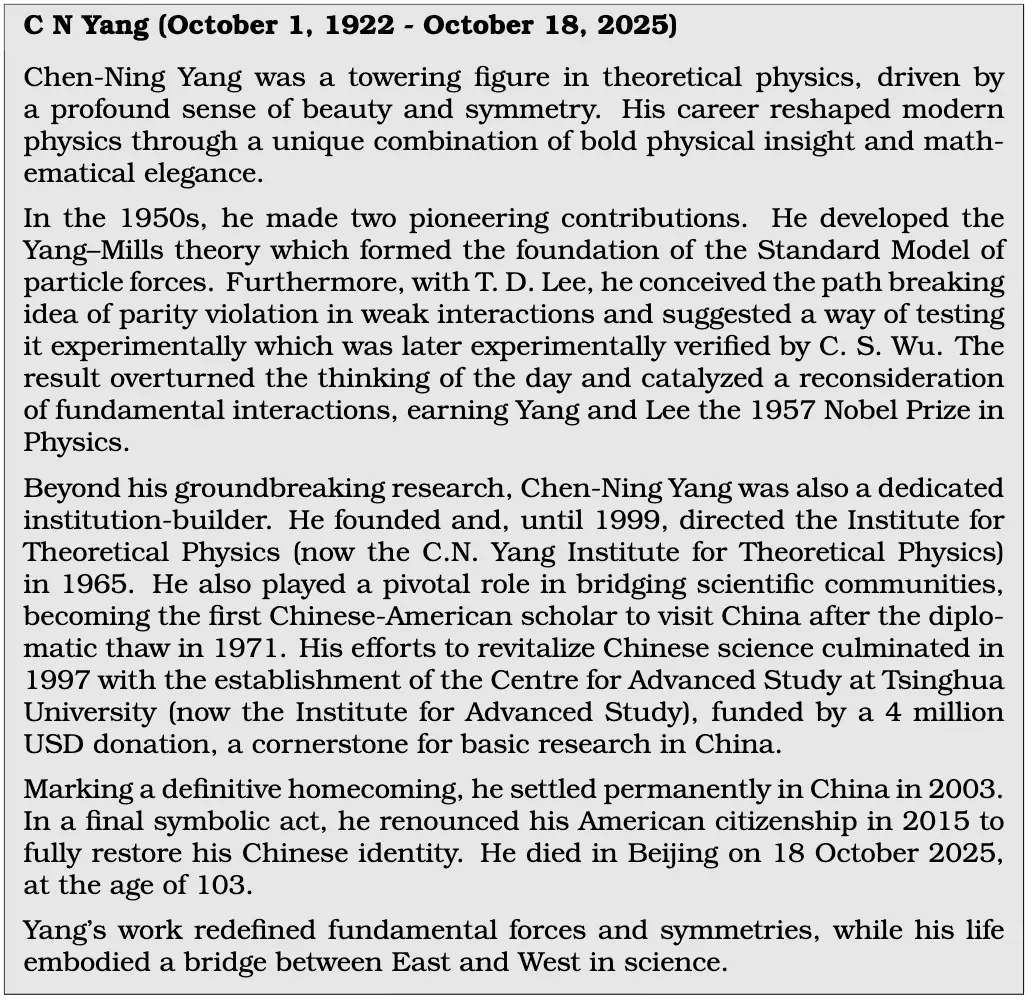
Selections from these conversations were originally published in The Statesman in 1997 and are reproduced here with permission. In light of Professor Yang’s recent passing on October 18, 2025, our conversations take on renewed poignancy, and their republication is intended to honor his memory. To provide appropriate context, I begin with a concise introduction to Professor Yang, whose scientific contributions and philosophical insights continue to exert a profound influence on the field.
Home: I gather that you grew up in an economically backward region of China where there wasn’t even electricity when you were a boy. To what extent was your education affected?
Yang: Well, though I was born in a backward town, I was fortunate to get the best that the Chinese educational system could offer. My father did his Ph.D. in the USA and went back to China when I was six. I was lucky to have an inspiring atmosphere and contact with learning in the best possible way. I took my master’s degree from the South-West Associated University, where my father taught, and then went to SA to earn my Ph.D. The reason I went to the University of Chicago was that I knew that one of the most outstanding physicists of our time, Enrico Fermi, was going to be there. I was therefore able to immerse myself in the best of the American system.
I tell my graduate students from China, “You go to a seminar and most of the time you didn’t quite understand what was going on. But you don’t have to be afraid. You go there a second time, and you will find that you learn more.”
Home: Now, looking back in retrospect, what were the important benefits you think you could derive during your Ph.D. work in Chicago?
Yang: I benefited particularly because what was emphasised was not necessarily what was in books, but a constant striving to think and attempt imaginative leaps. There is a tendency among the students in the Orient to be too timid, and they are strongly influenced by the dictum, “I have to follow the rules. The rules have already been given.”
Home: This is a very interesting thought, I think, which is quite relevant to the Indian context. Can you elaborate on this?
Yang: I tell my graduate students from China, “You go to a seminar, and most of the time you don’t quite understand what was going on. But you don’t have t o be afraid. You go there a second time, and you will find that you learn more.” I call this learning by osmosis; it was one of the things I learnt after I came to the USA. While working at the frontiers, you are always half-knowing and half-not-knowing. I came to know this especially from Edward Teller, who was my thesis adviser. He probably had 10 ideas a day, most of them wrong. But he was not afraid to talk about them. This greatly impressed me. Graduate students from the Orient make very good grades, but they are, in general, somewhat restrained from making imaginative jumps.
Home: If your kids had been raised in China instead of in America, how would their education have been different?
Yang: I’m glad you asked me this question. I’ve speculated on this. I think they would have learned more things that require long and diligent studying. In this respect, the educational system in the Orient has a great advantage. One manifestation of that is that, if you give high school kids science or mathematics quizzes, American kids, on average, don’t do as well.
Home: So, according to you, there’s a trade-off. In the Orient, we get a more studious student, someone who’s willing to work diligently. But they, in general, tend to lack the creative daring of the individual spirit that soars beyond the accepted domain. Now, what about Europe?
Yang: In this respect, the Orient is not the only example. If you compare the Orient with European and American cultures, Europe is somewhere in between the two, maybe two-thirds of the way closer to the American culture than the Orient in this particular respect. The European students, I think, are usually better trained but less daring than the American students.
Home: In a recent television interview I saw, you referred to Japan’s emphasis on education and commented that the Japanese seem to have blended the philosophy of the Orient with Western scientific thinking in a way that has benefited them.
Yang: A number of years ago, a social scientist, Vogel, wrote a book analysing why Japan had made such tremendous progress. One of the major reasons he thought was that Japan put a greater emphasis on education, even compared to the most advanced countries in the West. The other day, I heard that Japan, with half the population of the USA, produced twiceas many scientists and engineers every year.
You know that after the War the first priority of the Japanese was to rebuild their economy, and they did that in a single-minded way. Now I see that they realise that their economy is in good shape, at least as compared to many other societies. They now want to forge ahead in basic sciences, to which they did not pay that much attention as compared to applied areas in the last 40 years.
Home: It should, in particular, be quite instructive to us to know your impressions about the great physicist Enrico Fermi, who was your teacher.
Yang: I would say that the first impression I had of Fermi was his solidity as a physicist. He consciously wanted to stay close to reality. His way of thinking about physics was very much like his papers. He always started from the concrete, from the simpler examples, rather than from some general principles. To give an example, in a number theory problem, he would start by looking up the cases n=1, n=2, n=3… and then generalise rather than tackle the problem at the nth level.
I had also noted that Enrico Fermi used his time very effectively and efficiently. He kept well-organised notes in a way clearly designed for himself. It required tremendous willpower and discipline to keep such systematic notes. I tried but could not follow the method.
I had also noted that he used his time very effectively and efficiently. He kept well-organized notes in a way clearly designed for himself. If someone raised a question like, “How do you explain the Thomas factor of 2?” he would say, “Let me think. I had worried about this in the year 1927,” then pull out his notes from 1927 and look up the index. Usually, he could find it very fast. Then he would look at the notes and explain the answer to us. It required tremendous willpower and discipline to keep such systematic notes. Personally, I tried but could not follow Fermi’s method. However, I do realise the value of this method and would say that his solidity as a physicist derived primarily from his conscious effort to systematise what he had already acquired as knowledge.
Home: There have been considerable discussions from a historical standpoint about the events that culminated in your Nobel Prize-winning work with T.D. Lee on parity violation. If I may summarise the situation without going into technicalities, I shall put it this way. Certain puzzling problems concerning particle decays prompted this stunningly daring insight from you and T.D. Lee. What you suggested is that one way out of the difficulty would be to assume that parity or reflection symmetry is not conserved, specifically in weak interactions. You analysed this possibility in your paper (published in October 1956) against the backdrop of the then-existing experimental evidence of parity conservation. What you concluded is that to decide unequivocally whether parity is conserved in weak interactions, one must perform a new experiment to determine whether weak interactions differentiate the right from the left.
Yang: Yes, I agree with your summing up. We analysed the available experimental evidence at the time and concluded that there was, in fact, no experimental proof that the weak interactions conserve parity. We therefore stressed the need to test unambiguously whether parity was indeed conserved in weak interactions.
Before us, there were off-the-cuff speculations, but they lacked depth. The possibility that parity could be violated in weak interactions alone was generally considered to be unacceptable.
Home: Yes, a stalwart like Wolfgang Pauli had even remarked, ” I don’t believe that the Lord is a weak left-hander.” But the skeptics had to yield when, after the publication of your suggestion, Madame Wu and her collaborators experimentally demonstrated that electrons emitted from radioactive cobalt had a preferred direction, showing that the weak interactions responsible for cobalt’s radioactivity were indeed asymmetric between left and right.
Yang: Yes, apart from Pauli, there were other eminent physicists, like Freeman Dyson, who did not pay much attention to our paper.
Home: In this context, it could be interesting to recall that the original manuscript of your paper on parity violation submitted to the Physical Review had a title in the form of a question: “Is parity conserved in weak interactions?” But the Editor S. Goudsmit wanted the title to be changed, and you had to change it to a more neutral title, “Question of parity conservation in weak interactions.”
Yang: Yes, you have the story exactly right. This is a general situation in human development — as an enterprise or institution becomes more mature, it tends to become more conservative and impose more constraints.
Home: When you won the Nobel Prize in 1957, you were in America. What was the impact in China?
Yang: In the late 1870s, there were congressional hearings in America about whether there should be Chinese immigration limitations. There was a famous testimony by a so-called scholar that the Chinese people were undoubtedly inferior.
He supplied “scientific evidence.” He measured the size of the brain of different racial groups and claimed to prove that the Chinese were definitely inferior. That was a manifestation of a feeling at that time among many people that the Chinese could not develop modern science. This deeply hurt the Chinese people. So, I would say that if you want to ask what the most important reaction in China was to the announcement that my friend and I had won the Nobel Prize, it was tremendous pride.
In the day-to-day life of a truly committed scientist, the greatest attraction is not likely to be the materialistic rewards or practical applications of what he or she does — it is that we have penetrated nature in a way which is awe-inspiring.
Home: Dirac preferred to tackle a complicated problem as a whole, while Heisenberg’s approach was to split a problem into small parts and tackle them separately. What methodology do you personally prefer in your research work?
Yang: In my case, it varies from problem t o problem. I have tackled problems in elementary particle physics as well as in statistical mechanics and solid-state physics.
My opinion is that you require different types of insights in different fields. I found my interest in different areas to be very useful for cross-fertilisation of ideas. I would say that if you have wide-ranging interests, then the experience in one field would benefit you in another field, and, of course, if the two fields merge, you have a tremendous advantage.
Home: At the end of the day, what do you think sustains a scientist researching in basic sciences?
Yang: In the day-to-day life of a truly committed scientist, the greatest attraction is not likely to be the materialistic rewards or practical applications of what he or she does — it is that we have penetrated nature in a way which is awe-inspiring. Laws and mathematical equations describing the physical world we see are the poetry of nature. They are beautiful and powerful because we can condense complicated phenomena into only a few laws and equations.
Greeks believed that some general harmony underlies the structure of the universe. We now understand, in part, what this harmony is — the underlying structure is built on some very general principles.
Usually, this theoretical understanding eventually turns out to be important for practical uses. When we really understand something in sufficient depth, I think our general experience is that we are finally able to use it in a major way. For instance, if there had been no fundamental understanding of electricity at the end of the last century, the 20th century would not look the way it does today. We can now manipulate electricity the way we do because, in the last century, scientists like Faraday and Maxwell analysed the nature of electricity and magnetism in a profound way.