



van Gogh
It will be difficult to find someone who has not been moved by the van Gogh painting ‘Starry Night.’ Among artists, it has inspired countless poems, songs, books, and among the general public, innumerable memes in recent times. Art historians have also come up with many ideas about the unique swirls around the stars in the painting. Some have opined that these may describe air turbulence. Some others have thought that they may have something to do with the fragile mental condition of van Gogh at the time of the execution of the painting. One reason for thinking so is that van Gogh was a patient at the Saint-Paul-de-Mausole asylum in Saint-Rémy-de-Provence, northern France, at that time.
But before one can address these questions, one must first establish whether or not the painter faithfully depicted what he saw in the sky. It is possible that some aspects of his painting came from his imagination. Or, it may be a mixture of both. This is what a few astronomers have tried to answer. Not only for this particular painting, but they have tried to determine the place and time of painting for other pieces of art as well. The role of scientists in the realm of art history is quite fascinating indeed.
Consider the case of this particular painting by van Gogh. The first question that comes to our mind is this: was it painted after dusk or before dawn? If one pays attention to the way van Gogh painted the Moon in relation to the horizon, one can easily figure out that it could not have been painted after dusk. In order to understand this, one should recall the reason why we see phases of the Moon. It is the portion of the Moon that is illuminated by sunrays that we see as a crescent Moon. In this painting, the crescent Moon is illuminated on the left side, implying that the Sun is located at the left of the Moon, but below the horizon.
If the time of the painting were after dusk, then the Moon would have to be in the northern sky above France. But this is impossible, because the Sun would have been below the horizon in the western direction, and in the northern hemisphere, the diurnal path of the Moon (or any other celestial object) in the sky is inclined towards the south. The point is that the Moon would have been in the southern sky, not in the northern sky.
Imagine standing on the equator. The path of celestial objects in the sky, as the Earth rotates, would be straight up from the horizon, rising perpendicularly, and then equally straight down the horizon. On the North Pole, the paths would be along the rim of the horizon. In an intermediate northern latitude, the paths would be tilted (the angle of the tilt being equal to ninety degrees minus the latitude) towards the north. It would be opposite in the southern hemisphere.
Therefore, the painting must have been done late at night. In this case, the Moon would have been in the southern sky, which makes sense for the sky above a northern hemisphere country like France. Furthermore, from the shape of the Moon, one can guess that it was around ten days (nights) after the full moon. The new moon was probably three to four days away.
Next, consider the possible date of the painting. Van Gogh had written a letter to his sister on 16 June of 1889 with a list of paintings he had completed until then. This letter did not mention the Starry Nights. But on 18th June, he wrote in a letter to his brother Theo: ‘At last I have a landscape with olive trees and also a new study of a starry sky.’ One can then surmise that the painting was done sometime between the 16th and 18th of June.
A glance at the local weather report from this time gives the same hint. It had rained quite heavily from 10th to 14th June, and the sky after 18th was also cloudy. Only the duration between the 15th and the 18th saw a clear sky at night. Van Gogh was not depressed at all. In a letter to Theo on 22nd May, he had written about recovering slowly: ‘I assure you that I am all right here, and that for the time being I see no reason at all to take lodgings in or around Paris.’ And also this: ‘At present this horror of life is already less pronounced, and the melancholy less acute.’ There is thus indirect evidence for the hypothesis that he could have painted ‘the Starry Nights’ in the middle of June 1889.
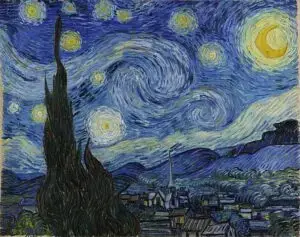
But this brings us to a puzzle. A look at the almanac tells us that the new moon that month was on the 28th. And the 18th night was the fifth after the full moon. It is impossible for the phase of the Moon to have been like the one depicted in the painting. The lit-up portion of the Moon should have been much bigger than shown, because the difference between the two phases (5th and 11th after full moon) is significant. Did van Gogh paint from memory? It is not an irrelevant question from the point of view of art history. Van Gogh was a true impressionist painter and preferred to draw from reality. In a letter to Emile Bernard (7th October 1888), he wrote about a painting: ‘I won’t sign this study, for I never work from memory.’ Could the ‘Starry Nights’ have been an exception in this regard?
It turns out that the answer is no. The positions of other celestial objects in the painting match well those from the night sky that night. Suppose that the time of the painting was 5.45am. If we look at the positions of stars and planets on 18th June as seen from Saint Remy, then we would find Venus shining bright in the eastern sky. The Moon would be located to its right. In the painting, one finds a bright object in the sky below (and to the left of) the Moon, to the right of the tall cypress tree. It appears to be brighter than other objects in the sky, at least judging from the amount of white paint van Gogh has used around it. We can guess that this was Venus.
Van Gogh had once mentioned in a letter to Theo that he used to watch the late-night sky from the window in his room. In a letter, written sometime between 31st May and 6th June, he wrote: “This morning I saw the countryside from my window a long time before sunrise with nothing but the morning star, which looked very big.” One can guess that he had been watching this scene for a few weeks, and the brightness of Venus made a lasting impression on his mind. His mind was probably working towards how he would depict the brightness of Venus in a painting. It was not the effect of watching Venus on a single night, but a cumulative effect of watching it for many nights. We probably see a combined effect of his memories from such sightings out of his window. Even though van Gogh did not usually paint from memory, what he saw in front of his eyes must have been combined with what he remembered before he conveyed his impressions on the canvas. Our astronomical analysis does hint towards this. As a matter of fact, in a letter to Theo in late 1888, he admitted that he was encouraged by Paul Gauguin:
Now I work from memory. Gauguin gives me courage to use my imagination, and it’s true enough that paintings of this kind have something mysterious about them.
It is likely that ‘Starry Nights’ is a ‘celestial composite,’ perhaps, as Charles Whitney had concluded, ‘constructed to make an image of the morning sky, perhaps for its connotation of rebirth.’
One also sees two bright stars on two sides of the cypress tree. They probably belong to the Aries constellation. This group of stars does not have any particularly bright stars, but the two brightest stars in this constellation are Hamal and Sheratan. If we use the hypothesis that van Gogh did combine some elements of memory in this painting, then one has to take into account what he saw in the evening sky, and not only in the dawn sky. According to Charles Whitney, the depiction of these two stars owed to van Gogh’s memory of the evening sky. The star on the left is, according to Whitney, most probably Vega. One can then ask if the ribbon-like structure near the horizon is the Milky Way. But the Milky Way is not visible in the dawn sky at that time, and appears as a strip in the evening sky along a north-south direction. Did van Gogh convey his impression of this in the painting he made before dawn? Note that, in a letter from the previous summer, van Gogh had described the ‘blue-whiteness’ of the Milky Way, which he could have seen from the east-facing room in the sanatorium.
What about the significance of the colourful swirls around the stars? Many commentators have said that they depict spiral galaxies. During van Gogh’s time, a book by Camille Flammarion, a French astronomer (often referred to as the French ‘Carl Sagan’ of the 19th century), became quite popular. Van Gogh’s painting resembles the descriptions of the Milky Way in the book in many regards. ‘Les Etoiles’ (1882) had reproduced Earl Rosse’s (William Parsons) sketch of the Whirlpool nebula, and wrote that our Milky Way resembles it [1].1 Flammarion went on to describe the Milky Way thus:
A whitish track rises like an aerial arch across the starry vault; the eye discovers bizarre irregularities: here, it flows like a celestial river in a narrow and monotonous bed; there, it divides into two separating branches; further on, it seems to tear into shreds like a fleece combed by the winds of the sky.
One wonders if the ‘winds of the sky’ became one with the ferocious dry wind that blows often in the valley where van Gogh was (and which is often mentioned in van Gogh’s letters), that he imparted a wind-blown appearance to his painting? There is no hard evidence that he ever read Flammarion’s book. But it is well-known that he was a voracious reader.
Van Gogh picked up his brush to paint the night sky on several occasions. In his letter to Theo two days before his suicide, he wrote:
For myself, I declare I don’t know anything about it. But the sight of the stars always makes me dream in as simple a way as the black spots on the map, representing towns and villages, make me dream. Why, I say to myself, should the spots of light in the firmament be less accessible to us than the black spots on the map of France. Just as we take the train to go to Tarascon or Rouen, we take death to go to a star. What’s certainly true in this argument is that while alive, we cannot go to a star, any more than once dead we’d be able to take the train.
Clearly, he was as much drawn to the beauty of the night sky as to the allure of death!
One can see stars in his painting of the Café at night. There is another famous painting of his from September 1888, showing the banks of the Rhine River. He had described the scene in a letter to Theo: ‘Against the green-blue field of the sky the Great Bear has a green and pink sparkle whose discreet paleness contrasts with the harsh gold of the gaslight.’ One can clearly recognise the seven stars of the Great Bear, but he seems to have changed the positions of certain other stars. And two stars below the Great Bear, near the horizon, are most probably drawn from imagination.
When was this painting done? We know that all stars in the sky rotate around the North Star. One can therefore estimate the time from their positions in the sky, like a clock, but one needs to know the date and year. Weather reports from that region tell us that the sky was clear between 15th and 22nd September, and after raining for four nights, the sky became clear again on 27th. We see that the Big Dipper constellation is almost parallel to the horizon in the painting. If we assume late September to be the period of painting, then according to Charles Whitney, this configuration with the horizon matches well with what one would expect around 11 pm. Of course, this conclusion assumes that van Gogh did not deliberately put it parallel to the horizon for some reason or other.
A bit of astronomical thinking can tell us more about the painting. The two ‘pointer stars’ of the Great Bear are placed one above the other, and they point to the North Star just outside the top of the frame. From this, one can determine the latitude of the place and check whether or not it matches that of Arles. For this, we need to estimate angles in the painting. We know that the Great Bear extends roughly 25 degrees from one end to the other. Using this as a ruler, one can estimate the base of the Great Bear to be 11 degrees above the horizon. But this is 33 degrees away from the North Star, which implies that the North Star is 33+11=44 degrees from the horizon. This is quite close to the latitude of Arles (43.5 degrees), and so this interpretation is consistent with what van Gogh would have seen.
But this leads us to a puzzle. Van Gogh was standing on the eastern shore of the river while painting this. From the shape of the riverbank in the painting, one surmises that he was looking at the southwestern sky. But the Great Bear is not visible in that part of the sky — it lies in the northern sky! Also, the full moon would have shone on the 18th, which, although making the riverbank bright enough for van Gogh to walk around, would have obliterated all but the bright stars for several nights. Clearly, he deliberately painted the Great Bear stars in this part of the sky even though they were not there, because there were no bright stars in that part of the sky! This case of transposing the stars from one part of the sky to another part in the painting is similar to what we have found in the case of the ‘Starry Nights.’ He had probably done this from his aesthetic sense, and we get a glimpse of how he could have possibly thought, based on the astronomical analysis of the painting.
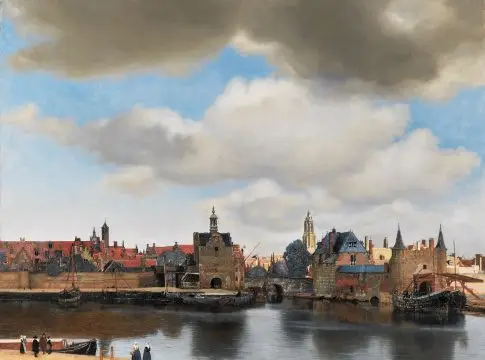
Vermeer
Such an analysis need not be limited to only night-time paintings. One can also analyse the sunlight and shadow. A group of astronomers has studied the famous painting ‘View of Delft’ by the Dutch master Vermeer [2]. There is a lot of uncertainty regarding the date and time of the painting, because of the lack of information on the details of life. Art historians think that it was painted in late spring or early summer of 1660. But the time of the painting has been a matter of debate. In 2020, Donald Olson and Russel Descher of Texas State University found a definitive answer to this question and claimed that it was painted on 3rd September 1659, around 8 am.
First, they collected the maps of Delft from that time and identified the church and the houses from the painting, in order to determine the vantage point from where Vermeer painted the scene. For this purpose, a mere 2-dimensional map would not have been sufficient. They needed to use software like Google Earth in order to find out the heights of different locations.
Then they visited the city, along with a number of students, and took photographs of the houses that were shown in the painting, from different locations. Most art historians had been of the opinion that Vermeer had deliberately enlarged the size of the Nieuwe Kerk (New Church), making it look almost twice its actual size. But the pictures taken by the Olson-Descher team showed that Vermeer had painted it exactly as he saw it.
Then they noticed the tall vertical openings in the stone octagon of the New Church in the painting. The narrow, illuminated vertical columns show a fascinating juxtaposition of light and shadow. In particular, the middle column is seen to cast a shadow on the column on the left, and only a sliver of sunlight falls on the left column. This sliver of sunlight was the key to understanding the date and time of the painting.
Vermeer had painted a clock on the front of the Church. Until now, art historians had said, on the basis of this clock in the painting, that it was painted right after 7 am. Olson and Descher, however, found, from old documents from that era, that the church clock did not have a minute hand. From this, they surmised that the time of the painting was 8am. They also found that the church bell, which does not figure in the painting, was built in September of 1660. This implied that Vermeer painted the scene before this month.
Then they carried out astronomical calculations to determine on which day the sun would have been in the particular part of the sky that would match the sliver of sunlight on the vertical column of the octagon. We usually tend to think that the Sun appears at the same part of the sky at 8 am every day throughout the year. But that is not so, and it changes with seasons. They used these clues to fix the date of the painting, which they found to be either 6-8 April or 3-4 September. From the trees in the painting, one can guess that it could not have been in April, and so it must have been 3-4 September of the previous year, 1659. Note that this differs significantly from what the art historians have been saying for a long time.
Vermeer used to paint rather slowly, so it may not be that he finished the painting on that day itself. He could have made sketches of the scene for a few months and done preliminary parts of the painting. What one can say with some confidence is that he painted the New Church and its clock on that day in 1659.
Conclusion
Donald Olson has analysed several such paintings, which he described in his book ‘Celestial Sleuth’ (2014) [3]. The examples he discussed in the book tell us about a fascinating interface between science and art, between aesthetics and rigorous calculations from astronomical principles.
These celestial investigations teach us something profound: art and science enrich each other. By combining astronomical tools with art history, researchers have not only dated paintings with surprising precision but have also shown us that artists were keen observers of the natural world. In Van Gogh’s night sky and Vermeer’s morning light, each brushstroke becomes a data point in a grand cosmic tableau. As one commentator observed, 400 years after Galileo and decades after C.P. Snow’s “The Two Cultures” [4], art and science are ultimately inseparable. When scientists trace sunlight on an old canvas or match painted stars to real constellations, it doesn’t diminish the magic – it magnifies it. We gain a fuller understanding of the masterpiece and a deeper appreciation for the artist’s vision. The scene still astonishes us – but now we also marvel at the fact that it was grounded in the real universe, as precise as a celestial clock. Every painting is both a work of imagination and a record of observation, inviting us to see familiar art in a new light. And perhaps the greatest wonder of all is this: in the interplay of science and creativity, each discipline opens a window into the other, and our curiosity grows ever larger, stretching from the canvas to the stars.
References
- C. Flammarion, Les Étoiles et les curiosités du ciel: description complète du ciel visible à l’œil nu et de tous les objets célestes faciles à observer. Paris, France: C. Marpon & E. Flammarion, 1882. Supplément de L’astronomie populaire, 792 pp., illustré de figures et cartes célestes.
- D. W. Olson, Investigating Art, History, and Literature with Astronomy (Springer Praxis Books), 1st ed., en. Cham, Switzerland: Springer Nature, Mar. 2022.
- D. Olson, Celestial Sleuth. Jan. 2014. ISBN: 978-1-4614-8402-8. DOI: 10.1007/978-1-4614-8403-5 .
- C. P. Snow, “The Two Cultures,” Leonardo, vol. 23, no. 2/3, pp. 169–173, 1990.
- Camille Flammarion’s Les Étoiles (1882), a widely read popular astronomy book of the late nineteenth century, reproduced Lord Rosse’s sketch of the Whirlpool Nebula and suggested that the Milky Way might possess a similar spiral structure. Such imagery and ideas were therefore available to educated readers during van Gogh’s lifetime, making it plausible — though not provable — that contemporary astronomical descriptions influenced the swirling forms in his night skies. ↩︎