

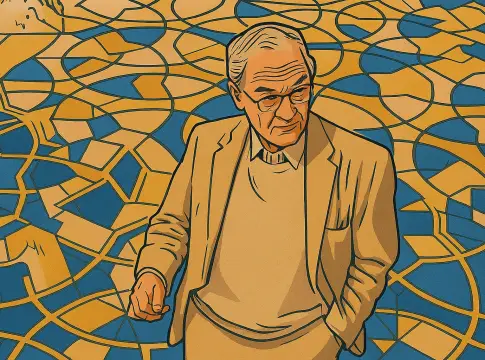


Picture a mind unafraid to pursue the Universe’s deepest mysteries — one that explores subatomic secrets and maps the cosmic order shaping our lives. Sir Roger Penrose, a Nobel laureate and revolutionary thinker, demonstrated to the world that black holes are not just a fantasy but an inevitable outcome of Einstein’s theory, transforming our understanding of gravity and our place in the cosmos. His vision has forever changed our understanding of the very fabric of reality.
Sir Roger was awarded the 2020 Nobel Prize in Physics “for the discovery that black hole formation is a robust prediction of the general theory of relativity.” His groundbreaking ideas have been explored extensively in numerous interviews and essays, marking him as one of the most original and provocative voices in contemporary science. If you are interested in learning more about Roger Penrose’s life and work, please visit this post!
Between December 2021 and March 2024, Professor Dipankar Home of the Bose Institute, Kolkata, and science writer Kaushik Sengupta engaged in a series of discussions with Sir Roger Penrose on three separate occasions. These dialogues spanned a broad spectrum of topics drawn from Penrose’s vast body of work, with a particular focus on quantum mechanics and quantum information theory.
The current post is about those discussions. It contains three parts: the first, called “Conversations with Professor Penrose,” presents a carefully structured transcript of the exchanges with Prof. Penrose on various topics related to quantum mechanics and quantum information theory. To enhance clarity, the material has been thematically categorized, and some adjustments have been made to preserve logical flow while eliminating repetition. Notably, Professor Penrose occasionally revisited key topics across sessions or elaborated on tangential points, enriching the discourse. The transcript consolidates these reflections into a cohesive narrative without redundancy. The part holds special significance, as it appears exactly 100 years after Werner Heisenberg’s groundbreaking introduction of matrix mechanics in 1925 — a pivotal milestone in the development of quantum theory.
The second part is a distillation of Penrose’s key insights on quantum mechanics, quantum information theory, and their broader implications. Designed for readers seeking a concise overview, this summary, titled “Summary of Penrose’s Perspectives,” captures the essence of Penrose’s insights during the discussions and his analytical framework — bridging physics, mathematics, and foundational questions about reality. Rather than delving into the full transcript, this section offers a streamlined yet insightful glimpse into his ideas, inviting further reflection and curiosity.
The final part of this post, called “Accessing the Full Conversations,” offers access to the original, unedited transcripts of the discussions with Professor Penrose. These detailed records — available only to registered members of Curiosita — go far beyond the curated excerpts shared above, including extended dialogues on gravitation, foundational physics, and Penrose’s broader theoretical ideas.
To enhance accessibility, we’ve included an engaging podcast that summarizes the key concepts while preserving the intellectual depth of the original material (scroll down to see).
1. Conversations with Roger Penrose
Discussions on Quantum Mechanics and Quantum Information Theory
Dpiankar Home and Kaushik Sengupta
2. Summary of Penrose’s Perspectives
We now provide a concise summary of Sir Roger Penrose’s perspectives on quantum mechanics and quantum information theory.
3. Accessing the Full Conversations
The original, unedited transcripts of the conversations with Prof. Penrose are available below:
Transforming Penrose Discussions into an Engaging Podcast
Before presenting the podcast, let’s briefly discuss how it was created. The original transcripts were imported into Google’s AI tool, NotebookLM, a platform uniquely suited for this project due to its focus on user-provided sources rather than generic training data. Doing it this way ensures that the output remains anchored in the original discussions, reflecting the depth and nuance of Penrose’s ideas. NotebookLM generated a dynamic dialogue between two characters: call them Alice (a curious student) and Bob (a knowledgeable teacher). Their conversation (AI-generated) synthesizes the core themes from the Penrose discussions into an engaging and digestible format — ideal for readers who seek both clarity and substantive insight without delving into the details of the original conversations.